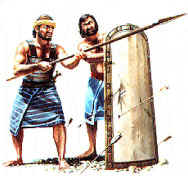
Showing posts with label religion.. Show all posts

Wednesday, 2 May 2018

THE CHRISTIAN SOLDIERS PATROITIC CALL.

Image result for christian soldier


                Hi, guys I am your top military niche blogger Afolabi Micheal and today I have for you a very special and weird post today as it may seem to you. Today post is on religion, when many hear of this religion stuff they shut down, block their ears ignore, scroll down or go away from the website. Pls, you can go out if you know that the world is safe with our armed forces, the armed forces are trying their best to protect their territory from external aggression but the sacrifices are too much, the death toll. You may stop reading this post if you are happy with the way defenders of our nations die in war. Religion here will be Christianity for now. Let me not be biased here before some human rights advocates charge me of inciting a religious violence, ignore my religion for now whether am a Christian, Muslim or a Taoist or a Buddhist that’s none of your business for now or you might be looking at my name Micheal unh! A Christian name. Forget that for now because am a voice crying in the wilderness.
            To the Christian soldier, Hello born and bred in Christianity, whether you attend morning mass, altar boy or you baptized by holy spirit or water, you are a Christian serving your nations army whether U.S.A, Nigeria, Britain, Germany, France, India or whatever, you are a Christian right! You are taught all the principles of the bible, but you are in the army but you don’t walk in the way your bible says simply because you are part Zion and part Babylon, you carry no anointing on your military career. If you don’t know everybody was called but called into different unit to serve the kingdom of God. You don’t have to be a pastor, pope or whatever before you can work miracles with God’s anointing. You are in the military so the Military is your ministry that God have given you to act on it but devil have given you sin to tap out your anointing from you.
You rely so much on technology, heavy weapons, martial arts, gears, air support, war skills but you forget your supreme source God! Jehovah who created the heaven and earth. I am not saying martial art, counter insurgency training or any other military training is not relevant, my point is what position did you put your God. The bible is no fiction book. There is an excuse people give that God can’t help in modern battles, people do quote Mike Tyson words which says “God take no sides in fight”. Mike Tyson was no affiliate of preaching the gospel so why should you rely on that, after all quotes are like pills that just can’t be applied on any ailments just because it a drug.
            Your God is a living and your God is almighty! Jehovah is the true God of war yet the culprit behind every war is the devil. Are you not tired of losing course mates at war, those bomb blast moments, the mortar strikes, the pains, the boredom, the PTSD, the heroic moment where you rise against all odds and do the impossible when outnumbered the next thing you realise is that you are awarded flashy medals and fame but when you leave the military, you watch the news headlines just to discover that the war still continues, all this led to frustration and you begin to question the role you played in defending your nation, questions like why did I lay so much sacrifices yet those dirty politicians on TV are meandering deadly policies that are bringing catastrophe to the nation.
 Aren’t you fed up of doing 500 pull ups, running 3000 miles, doing monstrous training that make you feel on top of the world but when outnumbered you discover that you are incapable of mustering a ripple. Turn to God, turn to your God Mr. Soldier because the greatest of any man is still a man no matter what!
            Where are the Samsons of our modern days, imaging killing a Lion with bare hands- no practise involved, no martial arts of any sort. Samson used just the jawbone of an ass to show thousands of philistine soldiers the way to hell (judges 15:14). These days we have chaplains at every barracks, born again soldiers that can preach every nook and cranny of the bible but when it comes to war, they end up telling you to face reality and forget the bible times.
            Hell no things still happen but no one is doing it the right way. Fasting all day, untarnished righteousness, get rid of things of the flesh, avoiding pornography, unceasing prayer, facing strong temptations, being the odd among worldly people, no Christian soldier is willing to go through all this but when it comes to the physical, they can push hard during strenuous physical training, lift weight and dumbbells, go several days without food all in the name of training, smash hands against bricks and palm trees and then pledge unalloyed loyalty and obedience to superior officers and nation. Their loyalty to God is filthy, they are like repented whores that you marry but keep catching them cheating on you after forgiveness of all previous acts. Strong physically but weak and fragile spiritually.
            I am not saying military training are not necessary, they are physically necessary but spiritually you need a higher power that is superb in the realm of the spirit. So funny to discover that some churches detest it members in participating in war or serving in the military, fine! We know the bible says the whole world is being controlled by influence of Satan and his army however the same bible proves to us that God’s Supremacy is sovereign and will continue to protect those that does his will. There is nothing wrong to see a well-seasoned Christian soldier foresees an incoming invasion or discover where the most wanted terrorist is hiding. Let’s take America for example after 9/11 attacks Osama Bin-laden was chased for a long number of years before being hunted down. Are there no Christians in the army or what went wrong, too much of emphasis placed on technological and war experienced to take down bin laden so God attention was not called upon I guess! Remember the story of Deborah in the bible- the fall of Sisera at Jael hands, if that’s a dumb story how about the red sea incident. The most exciting history is that of prophet Elijah and the soldiers sent to capture him, the fire that devoured the soldiers until they gave up (II kings 1-12) or the Assyrians that were slew by an angel of God (II Kings 19:35) or the war God helped Gideon to win by reducing his army (judges 7:25). Hello Christian soldiers I want you to remember that the battle is not yours (II chronicles 20:15).
            War on terrorism have been in existence since it started and it seems to have no end. Look at men that achieved awesome feats against all odds. Marcus lutrell, Cpl Dipprasad Pun, Joe crow, Punjabi Fazal Din, Paddy Mayne, Leo major, Simo Haya, Chris Ryan, Lev shetakov, Chris Kyle, Capt. Upham did their best in their war military careers but not without sacrifices- dead comrades, one arm, cracked skull and even reaching the point of death but miraculously saved. This guys are heroes but Like I said earlier the best of any man is still a man. God is the best avenger and there is none like him. Call on him, ask for the holy spirit directions in your operation. You might not necessarily shoot a gun let alone toss a grenade before victory. let me list:
 How about being a military surgeon gifted with the healing power to heal wounded soldiers and even win souls at the hospital bed.
Look at God awesomeness in II kings 19:35-6 or the story of Jericho. You know how silly it looks going to battle without a weapon but just trumpet and priests that’s damned ridiculous for modern war fare but however I implore you to know that the only limitation to God miracle or intervention is common sense. Cut down the sin that is limiting your impact on your relationship with God. There is this famous story about Alexander the great. In one of his conquest against Persia, he was conquering territories after territories until his soldier were weary, at this point a battle was to be fought the next day and Alexander the great knew that his soldiers were weary and this could to lead to a defeat, so he ordered that the bridge behind a valley where his army encamp should be cut down. In this case since the bridge is cut down the soldiers knew that when the war gets tough they have no option to flee back since the bridge to use as escape route have been cut down so the only option is Fight and slay all the enemies to get to the other side of the valley apparently victory is then established. The same thing as to go to you, cut down the bridge so that you can’t run away from God discipline, care, laws and love.
Here are testimonies of battle that was won through divine intervention.
 THE BATTLE OF THE BULGE
1.One of the bloodiest battles during World War II happened in the Belgian town of Bastogne in 1944 where the German army cornered American soldiers in a surprise attack.
12,000 American soldiers were encircled and trapped by the Germans, and it was up to US Third Army Gen George Patton to break the siege and rescue the 12,000 soldiers in Bastogne, promising that he would grease up his tanks with the guts of the Nazi soldiers.
A plan was already in place but, unfortunately for Patton, the weather had been relentlessly unforgiving. For an entire month, torrential rains pounded Belgium, and the chances of Patton’s troops marching into Bastogne were slowly being swept away by the waters. All Patton needed to be was 24 hours to send the Third Army to storm the town, rescue the 12,000 soldiers, and tear down the Nazi defenses.
Since no amount of screaming and cursing at the sky could stop the rains, Patton had to resort to an unconventional approach by commissioning Third Army chaplain Col James O’Neill to draft a prayer for him which he then distributed to his troops on wallet-sized cards. For the next few days, Patton ordered his troops to recite the prayer as they waited for the rains to let up.
Whether or not Patton’s unorthodox approach worked and summoned the God to stop the rain, the weather cleared, and his troops were given just enough time to break through the Nazi encirclement, save the trapped American troops, and reclaim Bastogne for the Allied forces.
No matter what the opinion is about the events surrounding the Battle of the Bulge, it was undoubtedly one of George Patton’s finest hours in the Second World War.

2.Greece is no stranger to the occasional invading army and bloody war against neighboring countries. With its trove of knowledge and wealth, the Ancient Greeks have always been one of history’s prime targets. Greece’s most formidable foe were the Persians.

In 492 BC, Greece came dangerously close to crumbling under the forces of the Persian army. Led by the Persian General Mardonius, Persia’s naval fleet was able to sail close to the island of Athos. Fortunately for the people of Athos, Poseidon was on their side. As if on cue, a wild hurricane swept the sea and in the blink of an eye, capsized and destroyed the Persian fleet killing 20,000 soldiers! It was believed Persia’s hubris brought this catastrophic end to their fleet. As the weather was already proving fickle when they reached Athos, the rains turned into a full-fledged storm.
While there have been many attempts by the Persians to set foot on Greece by way of the sea, this particular one may have succeeded if not for the winds blowing in favor of the Ancient Greeks.

3. THE PROTESTANT WIND

The political relations between Protestant England and Catholic Spain were already turning sour, and if not for the urging of Church leaders during the 16th Century, Spain may have saved herself from utter humiliation.
In one desperate attempt to subjugate Elizabeth I and England, King Philip II of Spain ordered the Spanish Armada to set sail to dethrone Elizabeth and claim the country in the name of the Catholic Church and the Spanish crown.
Despite the fact that Spain was no match for the English naval fleet, they continued to press on, and by the time they reached the English Channel, a storm that seemed to come out of nowhere battered the Spanish Armada, sinking ships and driving the survivors off.
Many from both sides who witnessed the event took the storms as a sign of intervention from God as Spain was pushed back and humiliated by what history dubs as “The Protestant Wind,” a sign that Providence greatly favored England and its Virgin Queen.

4.THE DIVINE WIND


If it weren’t for a helping hand from the heavens, Japanese culture would never have existed.
In 1247, the Mongol Empire had already conquered one-third of the globe and had cemented their power with one of the most formidable armies the world has ever seen.
As the Mongol army advanced further east unopposed, their next target was bringing down the Japanese Empire and annexing it to their strongholds in China. With inferior weapons and significantly fewer troops, Japan did not stand a chance against Kublai Khan’s fierce warriors and their allies.
As the Mongols sailed towards the shores of Japan with Korean allies, Japan sent as many forces as it could muster to defend its seawall. With what seems to be a losing battle, fortune turned its head towards Japan as the Mongol fleet sensed a storm brewing fast.
True enough, two typhoons came to the rescue of the Japanese Empire and decimated Kublai Khan’s rapidly advancing fleet.
The violent tempest, dubbed the Kamikaze or Divine Wind by the Japanese, left 13,000 soldiers dead and the remaining Mongol ships were sent fleeing back to Chinese shores.
 I think those testimonies are enough. there are several others too.
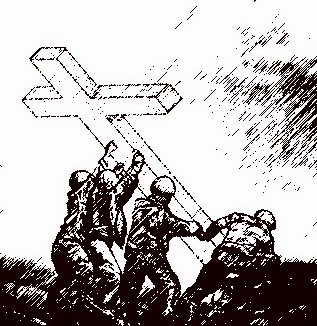
Some might say God is merciful so he doesn’t want Christian to kill, Go and ask your pastors the number of witches and magicians that died during a spiritual confrontation with them. Consider these stories from the new testament – what happened to Ananias and sapphire, or how Bar-Jesus got blind or the angel of God that turn a rescue Ops to release Peter from prison. How about you patrolling the jungle and a viper bit you in the hand, instead of yelling for a medic! Apostle Paul of the bible times shook the viper into the fire, Paul didn’t spare the viper to live, moreover Paul was alive, hale and hearty. You are a soldier and you should know that you might be required to kill especially in terms of war. Instead of killing how about using the power of God to neutralize the enemy and then start preaching the world of God into his life or deliver him to the authorities.                   Image result for christian soldier     War is ugly sometimes caused by selfish nature of man, crazy dictators, stupid politicians, hate speech. When the deed is done innocent people that didn’t start the fight will be required to fight in the fight. Muslim brothers and other religion brothers too are not left out of this case, if you believe so much in your religion then I believe you should call on what you believe to help you in your military career because the greatest of any man is still a man. Christian soldiers arise! Now your nation need you effectively, you are an envoy of God presence, take that presence to war and end all this bull shit once and for all or reduce it to minimum.
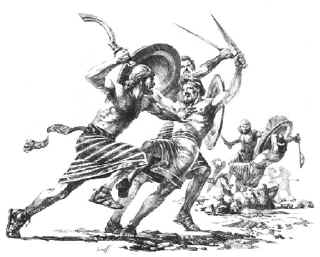
Thanks for reading this post, if you have any view, you can comment and share.

Wednesday, 21 March 2018

WEAPONS AND WARFARE AS OF OLD IN ANCIENT ISRAEL

 
The book of Judges describes the period when the Israelites were settling into the Promised Land following the Exodus from Egypt. Because the conquest was not complete, warfare was frequent, and resulted in the hero stories preserved in Judges. These heroes were known as "judges", meaning, not people who decided court cases, but military leaders who delivered Israel from her enemies. What weapons did these heroes use, and what was their strategy in defeating their enemies?
The Bible does not usually give a detailed description of weapons or of military strategy. Yet we have a good knowledge of weapons from archaeological discoveries and drawings, paintings and reliefs.

Offensive weapons

Offensive weapons in use at this time can be divided into three categories according to their range. Short-range weapons were used in hand-to-hand combat and included the sword or dagger and the spear. Medium-range weapons were designed to be thrown at enemies a short distance away. Occasionally spears were light enough to be thrown, but the shorter and lighter javelin was better suited for throwing. Long-range weapons could be thrown or fired at an enemy further away. Examples of long-range weapons include the sling, used to hurl stones, and the bow, for propelling arrows.
Armour was used to protect the foot soldier’s body as far as possible. Armour included the helmet for the head, scale armour, coats of mail, the breastplate for the body and greaves to cover the shins. The foot soldier also carried a shield to cover any unprotected parts of his body. An armour-bearer or shield-bearer could also be employed to carry the soldier’s weapons and his shield.
With this information, we can discuss the weapons and warfare described in the book of Judges, where we read "...not a shield or spear was seen among forty thousand in Israel" (Judges 5:8). Clearly weapons were in short supply, at least for the Israelites, an interpretation which is supported by the [above] lists of weapons mentioned in Judges.
These two lists of weapons reveal a striking contrast between Israel and her enemies. The Israelites used mostly "primitive" weapons, such as farm implements and household articles, and had few metal weapons. By contrast, their enemies possessed metal weapons, particularly iron weapons. Iron was much harder and more durable than bronze or copper, and its manufacture took greater technological skill than the Israelites possessed. The Iron Age commenced in Israel during the days of the judges...the Philistines already had something of a monopoly of iron metallurgy.... As long as the Philistines maintained this monopoly, Israel could not hope to dislodge them from the plain (Judges 1:19). On those occasions when the Israelites did prevail against their enemies, it was credited to divine help; some of their success must also have been the result of better strategy or tactics.

Iron chariots

Let us look first at the weapons of Israel’s enemies. We learn that the men of the tribe of Judah could not drive out the inhabitants of the plain because they had iron chariots (Judges 1:19). Pulled by two horses, the chariot was in effect a moving platform for two or three soldiers. It was most valuable in making rapid flanking movements where the land was fairly flat and open. The coastal area was relatively level, while the hill-country inland featured steep slopes and deep valleys. In ancient times the hills were heavily forested and Israelite guerilla tactics proved successful in this territory. However, in the coastal plain the Canaanite and Philistine iron chariots proved to be the tanks of their period, racing across the flat country. But chariots were ineffective on wooded hills.
Since the Iron Age had just begun in Canaan, iron chariots would have been the latest and best military weapon. Some scholars believe the iron would have been used to make part of the wheels and fittings of the chariot, while others think there was an iron plate to reinforce the wooden body of the chariot. In either case, the iron would have been superior to bronze, and would have made the chariot more durable.
Since Israel did not obtain chariots until the time of the monarchy, they simply could not dislodge the people of the coastal plain. But in one instance there was a strikingly different result. Jabin and Sisera, from the stronghold of Hazor, had a massive force of 900 iron chariots (Judges 4, 5). But Deborah and Barak, the Israelite leaders, were successful against this superior force because God routed the enemy. There is also the implication that there was a late spring storm which turned the river Kishon into a raging torrent and rendered the iron chariots useless in the battle.
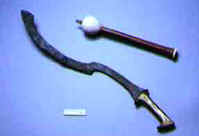
Apart from the chariots, the only other enemy weapon mentioned in Judges is the sword. The Midianites possessed them (Judges 7:22), but in their panic to flee from Gideon, killed one another....

The assassination of Eglon

Weapons from ancient Egypt. Photo courtesy of Dallas Brown, Southern Illinois University at Edwardsville
The Israelites also used some traditional weapons. The story of Ehud, who plotted a daring one-man assassination attack on King Eglon of Moab, is told in Judges 3:12-30. The standard sword of this period was curved, with one sharp edge used for slicing and slashing. It is sometimes called a sickle sword, and is the basis of the expression "smite the enemy with the edge of the sword" [see, for example, Judges 1:8, 25; 4:15; 18:27, KJV]. This type of weapon would not have served Ehud’s need, since it could not easily have been concealed from the palace guards, nor could it be used to thrust or stab to death. So the text explains: "Ehud had made a double-edged sword about a foot and a half long, which he strapped to his right thigh under his clothing" [Judges 3:16]. Such metal weapons were still very rare in Israel.
Because Ehud was left-handed, he hid his sword on the right side; right-handed soldiers would wear their swords on their left side. This reversal may explain Ehud’s success in getting past the king’s guards. By implying that he was the bearer of a confidential message, Ehud got rid of all of Eglon’s attendants. When Ehud told the king that his message was from God, Eglon stood up and put himself in an ideal position for Ehud to stab him with the concealed sword. As the sword had been designed for stabbing, it probably had a relatively short hilt, which would have penetrated Eglon’s fat body. Having accomplished his piece of treachery, Ehud fled, calling his waiting men into battle. With their king dead, the Moabites would have retreated hastily across the river Jordan to their homeland, or sought for reinforcements from Moabite territory. By taking control of the fords across the river, Ehud’s men were able to win the ensuing battle decisively.
In another incident the judge Gideon told his son, Jether, to kill Zebah and Zalmunna with a sword (Judges 8:20). However, Jether was afraid because of his youth, and Gideon did it himself. This is one of the rare instances recorded in the book of Judges of an Israelite using a sword.
After Gideon’s son Abimelech had been severely wounded, he asked his armour-bearer to kill him (Judges 9:54). The armour-bearer took the sword and killed Abimelech, as commanded. This was apparently one of the accepted functions of the armour-bearer in these times; later King Saul made a similar request of his own armour-bearer (1 Samuel 31:4).
There is no record in Judges of other individual Israelites using the sword, and the only other conventional weapon mentioned is the sling. We are told that 700 left-handed slingers from the tribe of Benjamin could sling a stone at a hair and not miss (Judges 20:16).

Alternative weapons

On the other hand, many other objects served as weapons when nothing better was available. We are told that Shamgar struck down 600 Philistines with an ox goad, in a tantalizingly brief reference (Judges 3:31). Perhaps he was ploughing with his oxen when the Philistines appeared over the hill. The ox goad was a farm implement, about two or three metres (eight or ten feet) in length, with one end pointed, and sometimes metal-tipped, to prod the ox to plough. The other end was fashioned with a scraper to dislodge the clods that became entangled in the plough. Shamgar’s heroic feat fits the pattern in the book of Judges of gaining victory with inferior weapons.
In Judges 4 and 5 we learn how Sisera fled the battlefield to avoid being killed or captured. He came to the tent of Jael, who seemed to offer him safety. However, while he was sleeping off his fatigue, she took a hammer and tent-peg and pounded the peg through his temple (Judges 4:21, 5:26). The hammer she used was probably made of stone, and the tent-peg a wooden object.

Gideon’s surprise attack

Gideon was faced with the task of fighting the Midianites (Judges 7). They had large encampments, with women, children, cattle, camels and tents, which meant their greatest weakness was that they could easily be panicked by a surprise attack. This was exactly the strategy that Gideon chose to employ, which explains why he used such a small force of only 300 men. The smaller the force, the less chance there was of detection in a surprise attack. Gideon divided his troops into three companies and positioned one company on each of three sides of the Midianite camp. He probably left open the east side, where the terrain was most problematic, so that any survivors would have had a difficult time if they fled.
Gideon waited until the Midianites were all sleeping soundly, and until the new sentries, unaccustomed to the darkness and to night conditions, came on duty. Since co-ordination is absolutely essential in a surprise attack, he himself was to signal the attack, to ensure that nobody made a false start. At his signal, everyone smashed his jar, blew his trumpet and shouted. The noise panicked the Midianites; when they looked out of their tents they saw the flickering torches, which could easily have been used to set the tents alight, and so increase the panic. Fearing that they were surrounded by a huge enemy force, the Midianites rushed to escape, falling on each other with their swords in the confusion. The surprise attack had succeeded to perfection, and Gideon won the battle with ease.
Another unusual weapon was used by a woman against Abimelech (Judges 9:50-54). When he attacked Thebez, all the people fled to the city’s tower. Safe in the tower, the woman waited till Abimelech was close to the entrance, then dropped a millstone on his head, mortally wounding him. A millstone was normally about five to eight centimetres (two or three inches) thick and 50 centimetres (eighteen inches) in diameter.

Samson’s weapons

Samson did not use orthodox weapons either. When he was met by a roaring lion, he had no weapons at all; using his bare hands and brute strength, he tore the lion apart as if it had been a tender young goat (Judges 14:6). On another occasion, he was weaponless because he had just been handed over to the Philistines. He picked up the fresh jawbone of a donkey (this must have been heavier and moister than an old, dried-out jawbone) and killed 1000 Philistines with it, wielding it like a club (Judges 15:15).
On another occasion, Samson went to Gaza, in Philistine territory, to visit a prostitute. Since it was night, the Philistines closed the city gate on him. (The city would have had a thick wall surrounding it, and only one exit.) When the hero went to leave, he found the gate barred shut. Undeterred, he pulled up the gate-posts and the gate itself, and walked free from the city (Judges 16:1-3). Since a city would have taken great pride in its fortifications, his action would have been a great humiliation to the citizens, and left the place temporarily defenceless. Finally, at the end of his life, Samson used his hands and arms to topple the columns of the Philistine temple and thus kill himself and 3000 Philistines with him.

Final battle

The last battle recorded in the book of Judges, the attack on Gibeah, gives an interesting account of battle tactics (Judges 20:18-48). As the defenders, the people of Gibeah and the Benjaminites had an advantage since they were fighting to defend their home territory. Israel’s two head-on assaults were successfully repulsed, as the town of Gibeah was well fortified and encircled by a thick, high wall.
On their third attempt, the Israelites set up an ambush out of sight of the city, and then pulled back their assault force as if in flight. The unsuspecting Benjaminites sallied out from the safety of the city to pursue the "fleeing" army, leaving Gibeah defenceless. At this point the ambush party attacked the city, and set it on fire. The clouds of smoke from the burning city acted as a signal to the assault force to turn and counter-attack the Benjaminites, now trapped between the Israelites and their burning city. The clouds of smoke from the destroyed city further demoralized them.
This civil war disaster and its aftermath led the writer of Judges to conclude the book with a strong plea for kingship: "In those days Israel had no king; everyone did as he saw fit" (Judges 21:25).


THANKS FOR READING BUT NOTE THAT THIS ARTCILE WAS POSTED BY AFOLABI MICHEAL FROM-James Moyer, Discovering the Bible: Archaeologists Look at Scripture, ed. Tim Dowley, Marshall Morgan & Scott Publications Ltd., Basingstoke, England, 1986, pp. 42-50.

Thursday, 15 February 2018

The Salvation Army and the Army of Salvation Compared.


If you grew up in London England or the united states The word salvation army is not strange to you. Though membership have spread across the world , there is a different  Popular religious quasi-military organization in Nigeria which is very different from Salvation Army. It is called Army of salvation though names may differ right now due to separation. Lets take a look at the Salvation Army First before anything.
THE SALVATION ARMY
Salvation army Logo


 The Salvation Army is a Protestant Christian para-church and an international charitable organization structured in a quasi-military fashion. The organization reports a worldwide membership of over 1.5 million, consisting of soldiers, officers and adherents known as Salvationists. Its founders Catherine and William Booth sought to bring salvation to the poor, destitute and hungry by meeting both their "physical and spiritual needs". It is present in 128 countries, running charity shops, operating shelters for the homeless and disaster relief and humanitarian aid to developing countries.
The theology of the Salvation Army is derived from that of Methodism, although it is distinctive in institution and practice. It does not celebrate the divine command of Baptism and Holy Communion. The Army's doctrine is typical of evangelical Protestant churches. The Army's purposes are "the advancement of the Christian religion ... of education, the relief of poverty, and other charitable objects beneficial to society or the community of mankind as a whole".
The Army was founded in 1865 in London by one-time Methodist circuit-preacher William Booth and his wife Catherine as the East London Christian Mission. In 1878 Booth reorganized the mission, becoming its first General and introducing the military structure which has been retained to the present day. The name "The Salvation Army" developed from an incident on 19 and 20 May. William Booth was dictating a letter to his secretary George Scott Railton and said, "We are a volunteer army." Bramwell Booth heard his father and said, "Volunteer! I'm no volunteer, I'm a regular!" Railton was instructed to cross out the word "volunteer" and substitute the word "salvation". The Salvation Army was modeled after the military, with its own flag (or colors) and its own hymns, often with words set to popular and folkloric tunes sung in the pubs. Booth and the other soldiers in "God's Army" would wear the Army's own uniform, for meetings and ministry work. He became the "General" and his other ministers were given appropriate ranks as "officers". Other members became "soldiers".
When William Booth became known as the General, His wonderful wife Catherine is known as the "Mother of The Salvation Army". William preached to the poor, and Catherine spoke to the wealthy, gaining financial support for their work. She also acted as a religious minister, who was unusual at the time hmm! (Gender segregation in the worship of God); the Foundation Deed of the Christian Mission states that women had the same rights to preach as men. William Booth described the organization’s approach: "The three ‘S's’ best expressed the way in which the Army administered to the 'down and outs': first, soup; second, soap; and finally, salvation."
In 1880, the Salvation Army started its work in three others countries: Australia, Ireland, and the United States. It was not always an Officer of The Salvation Army who started the Salvation Army in a new country; sometimes Salvationists emigrated to countries and started operating as "the Salvation Army" on their own authority. When the first official officers arrived in Australia and the United States, they found groups of Salvationists already waiting for them and started working with each other. In 1891 Booth established a farm colony in Hadleigh, Essex.
Their tremendous method of war was through soul winning. Fighting the holds of sin and evil,through preaching the world of God. The Salvation Army's main converts were at first alcoholics, morphine addicts, prostitutes and other "undesirables" unwelcome in polite Christian society, which helped prompt the Booths to start their own church. The Booths did not include the use of sacraments (mainly baptism and Holy Communion) in the Army's form of worship, believing that many Christians had come to rely on the outward signs of spiritual grace rather than on grace itself. Other beliefs are that its members should completely refrain from drinking alcohol (Holy Communion is not practiced), smoking, taking illegal drugs and gambling. Its soldiers wear a uniform tailored to the country in which they work; the uniform can be white, grey, navy, fawn and are even styled like a sari in some areas. Any member of the public is welcome to attend their meetings.
WAR
As the Salvation Army grew rapidly in the late 19th century, it generated opposition in England. Opponents, grouped under the name of the Skeleton Army, disrupted Salvation Army meetings and gatherings, with tactics such as throwing rocks, bones, rats, and tar as well as physical assaults on members of the Salvation Army. Much of this was led by pub owners who were losing business because of the Army's opposition to alcohol and targeting of the frequenters of saloons and public houses. The authorities of the Salvation army did their best to calm its members from retaliating to the provocation of the Skeleton Army.
The Salvation Army's  use so many methods to improve their reputation in the United States, following the Galveston Hurricane of 1900 and the 1906 San Francisco earthquake. The familiar use of bell ringers to solicit donations from passers-by "helps complete the American portrait of Christmas. In the U.S. alone, over 25,000 volunteers with red kettles are stationed near retail stores during the weeks preceding Christmas for fundraising. The church remains a highly visible and sometimes controversial presence in many parts of the world.
In 1994, the Chronicle of Philanthropy, an industry publication, released the results of the largest study of charitable and non-profit organization popularity and credibility. The study showed that The Salvation Army was ranked as the 4th "most popular charity/non-profit in America" of over 100 charities researched, with 47% of Americans over the age of 12 choosing 'Love' and 'Like A Lot' for The Salvation Army.
Charity Watch rates the Salvation Army an "A-" to an "A", indicating a high level of financial efficiency and organisational transparency.

As of 1 September 2015 the Salvation Army operates in 127 countries and provides services in 175 different languages. The Salvation Army operates structurally just like a conventional military in terms of administrative purposes, the Salvation Army divides itself geographically into territories, which are then sub-divided into divisions. In larger areas, regional and area commands are also introduced as sub-divisions of divisions. Each territory has an administrative hub known as territorial headquarters (THQ). Likewise, each division has a divisional headquarters (DHQ). Each of these territories is led by a territorial commander who receives orders from the Salvation Army's International Headquarters in London. A territory is normally led by an officer holding the rank of colonel (for small territories) or commissioner for larger territories. In some countries, the work of The Salvation Army may be called a command, led by a command commander. A larger command is typically led by an officer holding the rank of colonel.

Its stated membership (as quoted from 2010 Year Book) includes 16,938 active and 9,190 retired officers, 1,122,326 soldiers, 189,176 Adherents, 39,071 Corps Cadets, 378,009 Junior Soldiers, around 104,977 other employees and more than 4.5 million volunteers. Members of the Salvation Army also include "adherents"; these are people who do not make the commitment to be a soldier but who recognise the Salvation Army as their church. (According to the 2006 Salvation Army Year Book, in the United States there are 85,148 Senior Soldiers and 28,377 Junior Soldiers, 17,396 Adherents and around 60,000 employees.)
The current world leader of the Salvation Army is General André Cox.
The Salvation Army is one of the world's largest providers of social aid with expenditures including operating costs of $2.6 billion in 2004, helping more than 32 million people in the U.S. alone. In addition to community centres and disaster relief, the organisation does work in refugee camps, especially among displaced people in Africa. The Salvation Army has received an A− rating from the American Institute of Philanthropy. In the United Kingdom, the Salvation Army is no longer the largest non-governmental provider of social services; however, it still provides a significant service to people in need. The Salvation Army is the second largest charity in the United States, with private donations of almost $2 billion for the fiscal year ending 30 September 2007.
In 2004, the Army in the United States received a $1.6 billion donation in the will of Joan B. Kroc, third wife of former McDonald's CEO Ray Kroc. This donation was among the larger individual philanthropic gifts ever given to a single organisation. The donation came with certain restrictions that caused some controversy.
The International Congress of the Salvation Army is normally held every 10 years as a conference for all Salvationists from around the world to meet. The first such conference took place in London, UK, from 28 May to 4 June 1886, and subsequent Congressional meetings were held sporadically until 1904 and then 1990. The seventh International Congress in Atlanta, Georgia, United States, from 28 June to 2 July 2000, was the first held outside of the UK. The latest International Congress was held in London on 1–5 July 2015, in commemoration of the 150th Anniversary of the Salvation Army's founding.
Officers are given Marching Orders to change ministries within the Salvation Army. Usually, officers are given new Marching Orders every two to five years and reassigned to different posts, sometimes moving great distances.
A Moscow court ruled that the Salvation Army was a paramilitary organisation subject to expulsion. In October 2006, the European Court of Human Rights ruled the decision illegal.Beliefs

The denomination does not celebrate the Christian sacraments of Baptism and Holy Communion; although its officers conduct marriages, it holds a traditional Protestant belief that marriage was not instituted by Christ and therefore is not a sacrament.
The Salvation Army opposes euthanasia and assisted suicide. Its official stance on abortion is that "The Salvation Army believes in the sanctity of all human life and considers each person to be of infinite value and each life a gift from God to be cherished, nurtured and redeemed. Human life is sacred because it is made in the image of God and has an eternal destiny. (Genesis 1:27) Sacredness is not conferred, nor can it be taken away by human agreement." The Salvation Army official stance admitted in 2010 exceptions in cases such as rape and incest: "In addition, rape and incest are brutal acts of dominance violating women physically and emotionally. This situation represents a special case for the consideration of termination as the violation may be compounded by the continuation of the pregnancy." It is also against the death penalty: "The Salvation Army recognises that the opinions of Salvationists are divided on the moral acceptability of capital punishment and its effectiveness as a deterrent. However, to advocate in any way the continuance or restoration of capital punishment in any part of the world would be inconsistent with the Army's purposes and contrary to the Army's belief that all human life is sacred and that each human being, however wretched, can become a new person in Christ."
As of 2016 the organisation will not appoint homosexual people to posts as ministers, preferring individuals "whose values are consistent with the church's philosophy". The ordination of women is permitted in the Salvation Army. Salvation Army officers were previously allowed to marry only other officers (this rule varies in different countries); but this rule has been relaxed in recent years. Husbands and wives usually share the same rank and have the same or similar assignments; the major exception to this is the General's spouse, who holds the rank of commissioner.
The Salvation Army flag is a symbol of the Army's war against sin and social evils. The red on the flag symbolises the blood shed by Jesus Christ, the yellow for the fire of the Holy Spirit and the blue for the purity of God the Father.

Crest

The oldest official emblem of The Salvation Army is the crest.
In 1878 Captain W.H. Ebdon suggested a logo, and in 1879 it was to be found on the letterhead of the Salvation Army Headquarters. The captain's suggested design was changed only slightly and a crown was added.
The Army's crest proclaims Biblical truth though its symbolism:
  • The sun with its rays represents the light and fire of the Holy Spirit. (Matthew 3:11)
  • The cross represents the cross of Jesus on which He died as a sacrifice for our sins. (Romans 3:25)
  • The letter "S" represents the salvation which is available to all people through Jesus Christ. (John 3:16-17)
  • The crossed swords represent God’s Word (Hebrews 4:12). God's Word is the Christian’s weapon in the salvation war (the war against Satan and evil).
  • The Gospel shots (Psalm 119:160) represent the basic truths of the Gospel; there are 7 in all.
1 – The existence of a Holy God; 2 – The evil of sin are against God and man; 3 – There will be punishment for sin that is fair and everlasting; 4 – Jesus died on the cross for the human race; 5 – Salvation is for all mankind and is free to all who accept Jesus Christ; 6 – It is the responsibility of every Christian to do whatever they can do to spread the Gospel; 7 – God rewards those who are faithful with eternal life in Heaven with Him.
  • The words "Blood and Fire" as the "war cry" of the Salvation Army. It is Jesus' blood that washes us clean from sin and it is the fire of the Holy Spirit that makes us pure and helps us live lives that are pleasing to God.
  • The crown represents the "Crown of Life and Glory" which God will give to all those who have been faithful to Him (James 1:12).

Red Shield

The Red Shield has its origins in Salvation Army work during wartime. At the end of the 19th century, Staff-Captain Mary Murray was sent by William Booth to support British troops serving in the Boer War in South Africa. Then, in 1901, this same officer was given the task of establishing the Naval and Military League, the forerunner of the Red Shield Services.
Salvation Army officers serving in the Red Shield Services in wartime performed many functions. The Doughnut Girls of World War I are an early example, serving refreshments to troops in the trenches. They also provided first aid stations, ambulances, chaplaincy, social clubs, Christian worship and other front-line services.
This symbol is still used in Blue Shield Services that serve the British Armed Forces but it is widely used as a simple, more readily identifiable symbol in many Salvation Army settings. It is common to see the Red Shield used on casual Salvation Army uniform. It is now official Salvation Army policy in the UK that the red shield should be used as the external symbol of the Salvation Army, with the Crest only being used internally. Therefore, any new Salvation Army building will now have the red shield on the outside rather than the crest which certainly would have been used on its Corps (church) buildings.
In Australia, the Red Shield has become one of the country's most identified and trusted symbols, leading the Australian Salvation Army to prefer to use this symbol over the logo on its uniform, corps buildings and advertising materials. In the 5th volume of Australian Superbrands it was recorded that "Research reveals that the popular Salvation Army slogan 'Thank God for the Salvos' has almost total recognition amongst the Australian public, achieving 93 per cent aided awareness".

Uniform

Salvation Army officers and soldiers often wear uniforms. The idea that they should do so originated with Elijah Cadman who, at the Salvation Army's 'War Congress' in August 1878 said "I would like to wear a suit of clothes that would let everyone know I meant war to the teeth and salvation for the world". The uniform identifies the wearer as a Salvationist and a Christian. It also symbolises availability to those in need. The uniform takes many forms internationally but is characterised by the 'S' insignia for 'Salvation' and carries the meaning 'Saved to Serve', or 'Saved to Save'. Other letters are substituted to conform with local language.

The Salvation Army Dress Tartan
Since 1983 there has been an official Salvation Army tartan. It was designed by Captain Harry Cooper, for the Perth Citadel Corps centenary commemoration in Scotland. It is based upon the colours of the Salvation Army flag, with which it shares the same symbolism. However, it is rarely seen outside Scotland.

Salute

The Salvation Army has a unique form of salute which involves raising the right hand above shoulder-height with the index finger pointing upwards. It signifies recognition of a fellow citizen of heaven, and a pledge to do everything possible to get others to heaven also. In the case of saluting in response to applause, in circumstances such as a musical festival or being applauded for a speech, it also signifies that the Salvationist wishes to give Glory to God and not themselves.
In some instances, the salute is accompanied with a shout of 'hallelujah!'


Music playing
Salvation Army during a military parade an music playing

As the popularity of the organisation grew and Salvationists worked their way through the streets of London attempting to convert individuals, they were sometimes confronted with unruly crowds. A family of musicians (the Frys, from Alderbury, Wiltshire) began working with the Army as their "bodyguards" and played music to distract the crowds.
The tradition of having musicians available continued and eventually grew into standard brass bands. These are still seen in public at Army campaigns, as well as at other festivals, parades and at Christmas. Across the world the brass band has been an integral part of the Army’s ministry and an immediately recognisable symbol to Salvationists and non-Salvationists alike. The Salvation Army also has choirs; these are known as Songster Brigades, normally comprising the traditional soprano, alto, tenor and bass singers. The premier Songster Brigade in the Salvation Army is the International Staff Songsters (ISS).
The standard of playing is high and the Army operates bands at the international level, such as the International Staff Band (a brass band) which is the equal of professional ensembles although it does not participate in the brass band contest scene, and territorial levels such as the New York Staff Band. Some professional brass players and contesting brass band personnel have Salvation Army backgrounds. Many Salvation Army corps have brass bands that play at Salvation Army meetings, although not all.
The Salvation Army also fielded large concertina bands. From the turn of the (20th) century to the Second World War between a third and a half of all SA officers in Britain played concertina. For an evangelist the concertina's portability, its ability to play both melody and chords, and most especially the fact that the player can sing or speak while playing, were all distinct advantages over brass instruments.
The Army tradition in music is to use the popular idiom of the day to reach people for Jesus. The Army's Joy Strings were a hit pop group in the 1960s and early 1970s in the UK and beyond, reaching the charts and being featured on national television. Another popular band is The Insyderz, an American ska-core group popular in the 1990s and early 2000s. Hundreds of bands carry on this Salvation Army tradition, such as New Zealand's Moped, Chamberlain, Vatic, Agent C, Australia's Soteria Music Ministries, Summer Carnival Band, Crown of Thorns and Escape; and America's transMission, The Singing Company, HAB, BurN, and CJD – Cookies, Juice, & Donuts. Saytunes is a website designed to encourage and promote these contemporary Salvation Army bands and artists.
Another significant musical feature of the Salvation Army is its use of tambourines. With coloured ribbons representing the colours of the Salvation Army flag, timbrels play an integral facet of music in the Salvation army. They are mainly played by women.
Local corps usually sing contemporary worship music songs in Sunday worship services, as well as traditional hymns and music accompanied by the brass band.

Disaster relief

In the USA the Salvation Army's first major forays into disaster relief resulted from the tragedies of the Galveston Hurricane of 1900 and the 1906 San Francisco earthquake. The Salvationists' nationwide appeals for financial and material donations yielded tremendous support, enabling the Army to provide assistance to thousands. General Evangeline Booth, when she offered the services of Salvationists to President Woodrow Wilson during the First World War, thrust Salvation Army social and relief work to newer heights. Today the Salvation Army is best known for its charitable efforts.
The Salvation Army is a non-governmental relief agency and is usually among the first to arrive with help after natural or man-made disasters. They have worked to alleviate suffering and help people rebuild their lives. After the Indian Ocean tsunami in 2004, they arrived immediately at some of the worst disaster sites to help retrieve and bury the dead. Since then they have helped rebuild homes and construct new boats for people to recover their livelihood. Members were prominent among relief organisations after Hurricane Hugo and Hurricane Andrew and other such natural disasters in the United States. In August 2005, they supplied drinking water to poor people affected by the heat wave in the United States. Later in 2005 they responded to hurricanes Katrina and Rita. They have helped the victims of an earthquake in Indonesia in May 2006.

Since Hurricane Katrina struck the Gulf Coast, the Salvation Army has allocated donations of more than $365 million to serve more than 1.7 million people in nearly every state. The Army’s immediate response to Hurricane Katrina included the mobilisation of more than 178 canteen feeding units and 11 field kitchens which together have served more than 5.7 million hot meals, 8.3 million sandwiches, snacks and drinks. Its SATERN (Salvation Army Team Emergency Radio Network) network of amateur ham-radio operators picked up where modern communications left off to help locate more than 25,000 survivors. Salvation Army pastoral care counsellors were on hand to comfort the emotional and spiritual needs of 277,000 individuals. As part of the overall effort, Salvation Army officers, employees and volunteers have contributed more than 900,000 hours of service.
The Salvation Army was one of the first relief agencies on the scene of the September 11 attacks in New York City in 2001. They also provided prayer support for families of missing people.
The Salvation Army, along with the American National Red Cross, Southern Baptist Convention, and other disaster relief organisations, are national members of the National Voluntary Organizations Active in Disaster (NVOAD).
Also among the disaster relief capabilities is the Red Shield Defence Services, often called the SallyMan for short. The effort that they put in is similar to that of a chaplain, and reaches many more, offering cold drinks, hot drinks, and some biscuits for the soldiers of the military to have, though, if a SallyMan is on deployment, the locals are offered a share in the produce.
In Australia the Salvation Army have Emergency Services Support Units throughout the country, providing food and other welfare to members of the Emergency Services such as bushfires, floods, land search, and other both large- and small-scale emergency operations undertaken by Police, Fire, Ambulance and State Emergency Service members, and the general public affected by these events.

Thrift stores and charity shops

The Salvation Army is well known for its network of thrift stores or charity shops, colloquially referred to as "the Sally Ann" in Canada and "Salvos Stores" in Australia, which raise money for its rehabilitation programs by selling donated used items such as clothing, house wares and toys. Clothing collected by Salvation Army stores that are not sold on location are often sold wholesale on the global second hand clothing market.
The Salvation Army's fundraising shops in the United Kingdom participate in the UK government's Work Programme, a workfare programme where benefit claimants must work for no compensation for 20 to 40 hours per week over periods that can be as long as 6 months.

Red kettles

In many countries, the Salvation Army is most recognised during the Christmas season with its volunteers and employees who stand outside of businesses and play/sing Christmas carols, or ring bells to inspire passers-by to place donations of cash and cheques inside red kettles. A tradition has developed in the United States in which, in some places, gold coins or rings or bundles of large bills are anonymously inserted into the kettles. This was first recorded in 1982, in Crystal Lake, Illinois, a suburb of Chicago. The red kettles are not only used during the Christmas season though. They are used throughout the year at other fundraising events, such as on National Doughnut Day in the U.S. On this day, some donut shops that teamed up with the Salvation Army have a red kettle set up for donations.

Red Shield Appeal

The Red Shield Appeal is an annual fundraising campaign in some territories, such as the UK and Australia. Each year, officers, soldiers, employees and volunteers take to the streets worldwide to participate in door-to-door or street collections. The money raised is specifically channelled towards The Salvation Army's social work in each respective territory. Within the territory defined by the United Kingdom and Ireland (UKIT) this collection is known as the Annual Appeal, and it often carries another name that the generally public would more readily know – in 2012 becoming The Big Collection.

Family Tracing Service

The Family Tracing Service (sometimes known as the Missing Persons Service) was established in 1885, and the service is now available in most of the countries where The Salvation Army operates. The Tracing Service's objective is to restore (or to sustain) family relationships where contact has been lost, whether recently or in the distant past. Thousands of people are traced every year on behalf of their relatives.

Youth groups

The Salvation Army includes many youth groups, which primarily consist of its Sunday schools and the Scout and Guide packs that are sometimes set up. The Scout and Guide packs are affiliated and sponsored by the Salvation Army but are open units allowing anyone to join, these units/pack observe Christian standards and encourage the young people to investigate and develop in their Christian faith. Some territories have Salvation Army Guards and Legions Association (SAGALA). In the United States these internal youth groups that are specifically for females are known as Girl Guards (older females) and Sunbeams (younger females). Adventure Corps serves boys who are enrolled in school for first through eighth grade, and is sometimes separated into Rangers (older males) and Explorers (younger males).

Honours

General George Carpenter founded the Cross of the Order Of Distinguished Auxiliary Service in 1941 to express the Salvation Army's gratitude for service given to the organisation by non-Salvationists. The Cross has been awarded to parliamentarians, lawyers, doctors, financiers and members of the nobility.

Criticism by LGBT activists

Some in the United States have alleged that the Salvation Army discriminates against lesbian, gay, bisexual, and transgender (LGBT) individuals in its hiring practices. The Salvation Army states that it does not "discriminate against hiring gays and lesbians for the majority of its roughly 55,000 jobs”. Because the Salvation Army is a church, Title VII of the U.S. Civil Rights Act of 1964 allows it to inquire into people's religious beliefs in its hiring practices.
In 1997 the city of San Francisco enacted a law requiring all companies doing business with the city government to extend domestic benefits to same-sex partners of employees. In refusing to do so, the Salvation Army declined a US$3.5 million contract. In 2001, the Salvation Army pressed the Bush Administration to exempt it and other religious groups from anti-discrimination legislation which it felt infringed on the organization's religious freedoms. This request was denied, and was sharply rebuked by David Smith, then-spokesperson for the Human Rights Campaign. "Gays and lesbians are taxpayers, too," said Smith. "Their money should not be used by religious groups to fund discriminatory practices against them.".
The Salvation Army Western Territory approved a plan in October 2001 to start offering domestic partnership benefits to employees in same-sex relationships. Members of various evangelical Christian interest groups protested the decision. Focus on the Family founder James Dobson excoriated the Salvation Army for abandoning its "moral integrity" and urged his radio listeners to bombard the organisation's offices with phone calls and letters. The American Family Association also accused the Salvation Army of a "monstrous ... appeasement of sin" that resulted in a "betrayal of the church". In November 2001 the Salvation Army nationwide rescinded the Western Territory's decision with an announcement that it would only provide benefits coverage for different-sex spouses and dependent children of its employees.
In 2004, the Salvation Army said that it would close operations in New York City unless it was exempted from a municipal ordinance requiring them to offer benefits to gay employees' partners. The City Council refused to make the exemption. Mayor Michael R. Bloomberg's administration chose not to enforce the ordinance. The administration's right to decline to enforce the ordinance was upheld by the New York State Court of Appeals in 2006.
On 15 December 2012, in Canada, Andrea Le Good noticed a Salvation Army bell-ringer carrying a sign reading "if you support gay rights: please do not donate". While the bell-ringer claimed he had permission from the charity to wear the sign, Salvation Army spokeswoman Kyla Ferns said that it had no part in the sign, and that the bell-ringer was pulled away immediately when the charity learned about it. The charity's website describes marriage as heterosexual by definition, and a published document called on homosexuals to embrace celibacy as a way of life. The same document also states that there is no scriptural support for the mistreatment of homosexuals.
Before the passing of the Homosexual Law Reform Act 1986 by the New Zealand Parliament, the Salvation Army was active throughout New Zealand gathering signatures for a petition seeking to prevent the bill's passing. In 2006, the Army released a statement regretting the ill feelings that persisted following this activity. It stated in part "We do understand though that The Salvation Army's official opposition to the Reform Bill was deeply hurtful to many, and are distressed that ill-feeling still troubles our relationship with segments of the gay community. We regret any hurt that may remain from that turbulent time and our present hope is to rebuild bridges of understanding and dialogue between our movement and the gay community." Despite documented events of Salvation Army's volunteers and their views, the organisation has issued an LGBT Statement as a response. The statement does not address any documented news events of discrimination and claims to debunk these events as urban myth.
In November 2013 it was made known that the Salvation Army was referring LGBT individuals to one of several conversion therapy groups.As a response the Salvation Army removed such referrals from their website.

The Salvation Army's response

A positional statement on the Salvation Army UK and Ireland site stated (but has since been taken down):
The Salvation Army teaches that sexual acts should take place only in a monogamous heterosexual marriage, believing that this reflects God's intentions for sexual behaviour and provides the best environment for raising children.
The positional statement is, however, intended explicitly for members of the Salvation Army[and the Salvation Army mission statement as of 2013 states:
The Salvation Army stands against homophobia, which victimises people and can reinforce feelings of alienation, loneliness and despair. We want to be an inclusive church community where members of the LGBT community find welcome and the encouragement to develop their relationship with God ... Our international mission statement is very clear on this point when it says we will "meet human needs in [Jesus'] name without discrimination". Anyone who comes through our doors will be welcomed with love and service, based on their need and our capacity to provide.
As of late 2013, activists were still calling on the Salvation Army to change its stance on LGBT issues, citing ongoing discrimination.

Canadian charity work

During the 2010 Christmas season, the Salvation Army in Calgary, Alberta, refused to accept toys based on the Harry Potter and Twilight franchises because of a perceived conflict with the organisation's religious principles. One volunteer claimed that the toys were destroyed instead of being given to other agencies. The volunteer also criticised the Salvation Army for accepting violence-themed toys such as plastic rifles while not accepting Harry Potter or Twilight toys. A Salvation Army captain said that the toys were given to other organisations, not disposed of. This policy is however, not universal, as the Wetaskwin chapter of the Salvation Army has accepted Harry Potter toys. One captain called the series "a classic story of good winning over evil".
Also during the 2010 Christmas season, the Salvation Army in Vancouver, BC, came under fire for a program that provided goodie bags to federal inmates for Christmas by playing Santa to incarcerated criminals. This was however simply an extended outreach as part of the Salvation Army's prisoner visitation program established over a century ago.
 

THE ARMY OF SALVATION (C&S)
Army of Salvation Children members UK/Ireland
Now let us go back to the Army of Salvation. This is a religious quasi-military organization. The origin can be traced back to the establishment of a white garment church called (C&S) Cherubim and Seraphim in 1925 by Captain Abiodun Emmanuel and St. Moses Orimolade. The founder of Army of Salvation is argued till today because of the church were separated to different factions due to internal strife for leadership over the church(C&S) thus affecting the Army of Salvation itself. As the Church (C&S) separated the factions group went ahead to establish their own church and for sure they would established their own Army of Salvation without direct links from their source. However the  main (C&S) churces that can act as the source are Holy Mary Cathedral church of Christ Okesuna Lagos and St. Moses Orimolade Church at Ikare and eternal sacred order of Cherubim and seraphim. However the likely resemblance of the faction Army of Salvation will be discussed here.

FUNCTIONS


During Dance Parade
Photshoot 
Members of the band are known as soldiers of Christ, they perform similar functions just like the catholic altar boys such as taking care of the church altar, burning incense. Older Members usher new members into the congregation, discipline erring members like kids disrupting the church services with noises. Members act as spiritual representation of Heavenly angels meant to fight evil. They also perform security functions like safeguarding the church premises and its members, though they don’t use firearms or weapons. Members are often involved in military styled parade and they make use of their own music bands with the use of tambourines, trumpet, drums and saxophone similar to that of a military music band. Members are also tasked with wining souls for Christ and ensuring spiritual discipline among members. They are also perform entertainment functions by doing dance parades between church services backed up with the song of the church choir, the most common song they do dance parade to was a lively spiritual songs called Orin emi. They are used to act as fundraising mechanism during church anniversaries where they entertain church members with parades and church members spray them money. However their main function is mainly spiritual function. However have it mind that the army of salvation functions differ depending to the church where they were established
.
UNIFORM
The most popular uniform use is mainly a white colored standard typical military officer uniform. Red beret sometimes yellow depicting their logo depending on the church. A red and yellow girdle to cross their waist and shoulder. A white socks to the feet but sometimes barefooted in the church because of the denominational belief of all (C&S) churches that prohibit wearing of sandals, slippers or boots in the church because it is regarded a holy place of worship just like the Biblical experience of Moses at the burning bush. Lances are used sometimes by matured member of the army to do ceremonial parade. 
STRUCTURE
As said earlier structure differs depending on the church the army serves. Around 2011 several factions of the  Cherubim and seraphim churches came together to merge as one thus giving birth to (C&S) Unification. The C&S Unification council Army of Salvation was established to foster unity among various army of salvation of different churches. Presumably right now orders came from the Unification headquarters to others but yet there is still much differences between present Army of Salvationist because not all c&s churches are registered under unification. However ranks of the conventional military are used such as Recruit, Sergeant, captain, General with the exception of Field Marshal. Holy Micheal is regarded as the Chief of Army staff. Though there is human to act as Chief of Staffs but the chief of staff differs depending on the church. The only way there is flow of orders is if a particular church established other subsidiaries church so The Church in question thus become the Headquarters for flow of orders.
Hosting Flags

MEMBERSHIP
Membership is based on registration to the church and it is open to all adherent members, Popularly there is no age requirement, people can join at early age like 2 years upwards. Some are already enlisted by their parent’s right from birth. There is no specific number to describe the total number of the soldiers because the churches itself have spread abroad thus exporting its doctrines too to the newly established place abroad. Ireland, Great Britain, USA, Cuba, France, Benin republic, Togo, Ghana South Africa and Germany. These countries mentioned have (C&S) Army of Salvation in their white garment church.
ACHIEVEMENT
The Organization has produced notable members for the Military. Members use their experienced use in the Army of Salvation to their advantage when they want to join their country Military. With the exception of firearms and advanced training, Ones experience serving in the army is similar to that of the Military- the parades, orders, uniformity and discipline and training. Apparently Parents of C&S churches see the voluntary organization as an avenue for child disciplinary correction so they enlist any of their wayward church into the Organisation. It is also assume that serving under the army sincerely will grow up to be prominent and rich members of the society. A member once said that ”Normally in the white garment church if you don’t join any church group like the choir, prayer warriors, army of salvation, or other bands you will have a feeling of being lonely and lost without a sense of responsibility. Even a mere youth member pledge allegiance to the youth group. So joining the group give you a sense of belonging.
Notable members are Nigerian Army warrant Officer Kolawole.A he was once the Chief Of Army of Salvation staff at Holy land Cathedral church of Christ Ojo Lagos, another is Nigeria Hip Hop artiste Don Jazzy a member of the Army.
CONCLUSION
The differences between the Army of Salvation and the Salvation Army are that The S.A is a church on its own while the A.S is an organization within a church. S.A have wide membership almost in the whole world but the A.S have in few selected countries though the S.A claim a membership of 1,150,66 but the A.S does not have a formal record of their number but judging by the country it originated from- Nigeria, There are millions of C&S churches in Nigeria thus give the A.S more members not to talk of in other counties.
The S.A is more financially and structurally settled and more internationally recognized. However the both worship same God.