Sunday, 21 April 2019

Things you need to know about Sri Lanka bombings.

A series of eight devastating bomb blasts ripped through several high-end hotels and three churches holding Easter services in Sri Lanka on Sunday, killing more than 200 people and wounding 450 others.
It was the first major attack on the Indian Ocean island since the end of a civil war 10 years ago.
There were no immediate claims of responsibility.
The government declared a curfew in the country's capital, Colombo, and blocked access to social media and messaging sites, including Facebook and WhatsApp.
Here's what you need to know.
What happened?
The first blast was reported at St Anthony's Shrine, an historic Roman Catholic church in Colombo, just as church services began around 8:45am local time (03:15 GMT). Much of the church roof was blown out in the explosion, with roof tiles, glass and splintered wood littering the floor along with pools of blood.
The other two occurred at St Sebastian Catholic Church in Negombo, a majority Catholic town north of Colombo where footage showed people dragging the wounded out of blood-splattered pews, and at the Protestant Zion Church in the east-coast town of Batticaloa.
Soon after, police confirmed blasts at three high-end hotels in the capital - the Cinnamon Grand, the Shangri-La, and the Kingsbury.
Hours later, a blast was reported at a guesthouse near the national zoo in Colombo's Dehiwala district.
The eighth explosion took place at a house in Colombo. Police and media said three officers were killed.
Prime Minister Ranil Wickremesinghe said eight people were arrested in connection with the string of deadly blasts.
"So far the names that have come up are local," but investigators will look into whether the attackers had any "overseas links", he said.
Harsha de Silva, Sri Lanka's minister of economic reforms and public distribution, said he had been to two of the attacked hotels and was at the scene at St Anthony's, where he described "horrible scenes".
"I saw many body parts strewn all over," he tweeted, adding there were "many casualties including foreigners".
Who were the victims?
The blasts hit the churches when they were full of worshippers who gathered for Easter services. A detailed breakdown of casualties in the eight blasts was not immediately available.
"Altogether we have information of 207 dead from all hospitals. According to the information as of now we have 450 injured people admitted to hospitals," said Ruwan Gunasekara, the police spokesman.
Nearly all victims were Sri Lankans. Officials said the dead also included 27 foreigners.
At least 27 of the dead were foreigners. Sri Lanka's foreign ministry said they include three Indians, one Portuguese national, two Turkish nationals, three British nationals and two holding US and British nationalities.
A Dutch national and a Chinese national were also reported among the victims.
Sri Lankan security personnel walk through debris following an explosion in St Sebastian's Church in Negombo, north of the capital, Colombo [AFP]
Who did it?
There was no immediate claim of responsibility, but Defense Minister Ruwan Wijewardene described the blasts as a "terrorist attack" by religious groups.
At least 13 suspects are now in custody.
Prime Minister Ranil Wickremesinghe told reporters that "so far the names that have come up are local", but investigators will look into whether the suspected attackers had any "overseas links".
He also acknowledged that "information was there" about possible attacks. "While this goes on we must also look into why adequate precautions were not taken," he said.
How did Sri Lanka react?
In a Twitter post earlier on Sunday, Wickremesinghe said: "I strongly condemn the cowardly attacks on our people today. I call upon all Sri Lankans during this tragic time to remain united and strong."
President Maithripala Sirisena said he had ordered the police special task force and the military to investigate who was behind the attacks and their agenda.
In addition to the curfew, the military was deployed and security was stepped up at Colombo's international airport.
Sri Lankan military officials stand guard in front of the St Anthony's Shrine [Dinuka Liyanawatte/ Reuters]
What are world leaders saying?
Countries around the world condemned the attacks, and Pope Francis added an appeal at the end of his traditional Easter Sunday blessing to address the massacre.
Speaking from the loggia of St Peter's Basilica, Francis said: "I want to express my loving closeness to the Christian community, targeted while they were gathered in prayer, and all the victims of such cruel violence."
US President Donald Trump tweeted his condolences on the "horrible terrorist attacks", while Russian President Vladimir Putin said Moscow remains a "reliable partner of Sri Lanka in the fight against international terrorism".
Turkish President Recep Tayyip Erdogan called the bombings "an assault on all of humanity".
British Prime Minister Theresa May, condemning what she called the "truly appalling" attacks, said: "The acts of violence against churches and hotels in Sri Lanka are truly appalling, and my deepest sympathies go out to all of those affected at this tragic time."
Relatives of a blast victim grieve outside a morgue in Colombo, Sri Lanka [Eranga Jayawardena/AP]
Saad Hariri, Lebanon's prime minister, called the attacks "blind terrorism" and offered solidarity to Sri Lanka's people.
New Zealand , Germany, the United Kingdom , Iran, Bahrain, Qatar, Pakistan and the United Arab Emirates also denounced the attacks.
What is Sri Lanka's religious and ethnic mix?
The attacks on Sunday recalled the worst days of Sri Lanka's 26-year civil war, which claimed up to 100,000 lives.
The island nation has a population of nearly 23 million, of which nearly three-quarters are ethnic Sinhalese. The Tamils, the second-largest ethnic group, make up more than 15 percent of the population and live mainly in the north and northeast of the country.
Muslims account for 10 percent of the population, and Christians about six percent.
The mistreatment of Tamils following independence from the British helped nurture the growth of armed separatists, leading to nearly three decades of armed conflict. The government defeated Tamil separatists
in 2009.
After the civil war ended, a religious divide quickly took hold, with hardline Buddhist monks rallying Sri Lankans against Muslims.
In 2018, anti-Muslim violence flared across the hills of central Sri Lanka, fed by rumours spread over social media about attacks on Buddhists. A state of emergency was briefly declared in the wake of those attacks.
SOURCE: AL JAZEERA

Thursday, 18 April 2019

THE MOMENT WHERE FIGHT TO DEATH IS YOUR ONLY MEANS OF SURVIVAL

 for fight to death quotesOkay, this is not a martial art blog but a military one, but anything goes here as long as it is military related. Yeah I repeat martial art is related to the military, you should know that in courses Special Forces take and even the regular force.
However martial art is not just for men of war, it’s for everybody who values it. It’s been practiced all over the world. Many schools in China, India and mostly America the best market for the art and then few in my country here Nigeria. Increasing Terrorist attack and insecurity is causing people to take martial art classes. There are many martial artist masters but am not fortunate to be a master, many YouTube videos have provided martial art master to portray their technique more effective than their counterparts, without me digressing too much, Terrorist attack and mass shooting is getting more alarming even to the most unlikely countries where no one believe could happen .Self-defense and security consciousness is needed for every individual to prepare for the worst. In this article I want to treat an aspect that has to do with what to do in a close encounter with the attacker and as for the title above:  

What is the right moment where fight to death is the only means of survival or an advantage. Answer: when all odds are against you.
1.       PRETENDING TO BE DEAD: This art of defense is good, cunning and popular. effective if well played, funny enough some martial artist implore people to pretend to be dead amidst other dead bodies in a mass shooting or kidnapping spree but how good is that. In the Al-Noor terrorist attack in New Zealand attack, if you were able to watch the live video before the social media start deleting them, you will realize this technique doesn’t work in this scenario, the attacker (Breton Tarrant) was a mad man so over determined that he went into the AL Noor mosque twice to shoot all the dead bodies he once killed; such a heartless man. Anyone who applied the law of pretending to die is indirectly making the pretense a reality because Tarrant will sure come back after a round of shooting to shoot the dead bodies. The only art possible there is fighting to death; unfortunately the attack came as a surprise because no one in the mosque or nobody in Zealand expects a terrorist attack including me. The attack was too fast for any hero to think and rise, everyone was crippled with fear.
 However nobody is in any position to criticize any of the victims for not devising a means to fight back simply because being you are not there to witness the horrific event that can make you mess up your trousers.
Kudos to that guy at Linwood Mosque, he threw something at the attacker, he deserve a medal honor.
The only solution depends on the situation, if the scenario provide for pretense especially if the goal of the mass shooter is to kill as many as possible which is not to come and check whether any survived.so the chance of pretense is good here, but as I said earlier, am not a master, access your situation first.

2.       FIGHTING BACK OR SUICIDAL ATTACK: okay how about fighting back, if I say it depends on your martial art skills, that will be bad because fear can make a martial art lesson disappear in seconds, if I say it depends on your martial art or combat experience, then I may be right, however let consider those with no martial art training. What should they do.
Remembering the 9/11 attack in the USA, one of the planes (flight 93) hijacked heading towards a particular target didn’t go well as expected by the hijackers, why? The passengers knew in through their phones that that morning, Flights 11 and 175 had already crashed into the World Trade Center and Flight 77 was within 9 minutes of striking the Pentagon therefore flight 93 passengers revolted against the hijackers, although they couldn’t save themselves but they were able to give the hijackers a tough time controlling the plane effectively to its target. Out of panic of being run over by the revolting passengers, the hijackers crash-landed the plane into a field in  stone creek Pennsylvania. The act of the passengers made them became heroes.

Another example, in the Ancient Yoruba Kingdom in Nigeria, Warriors and Kings whenever they become betrayed and sold-out by somebody close to them, although dying, stabbed, poisoned, shot they make sure they finish up the traitor and then give up.
That’s the warrior mentality you should have in critical situation, and you may feel like what if I die, also think of what if you win. However this just an advice ascertain the situation and don’t forget the S.E.R.E survival Evasion Resistance and Escape. I remain Afolabi Micheal.
No website is an island of knowledge, feel free to drop your comments , don’t forget to share.

TOKYO – North Korean leader Kim Jong Un is cautiously turning up the heat after his unsuccessful summit with President Donald Trump in Hanoi two months ago.
Returning to military optics for the first time in five months, Kim on Tuesday paid a surprise visit to an Air Force base to inspect fighter combat readiness and followed that up the next day by supervising the test of what the North's official media described ominously but ambiguously — and without any photos or video — as a new type of "tactical guided weapon."
The military-related posturing comes after Kim expressed deep disappointment earlier this month with what the North claims was an inflexible, "gangster-like" demands by the U.S. in Hanoi.
It also comes amid reports that Kim may hold his first summit with Putin next week in Vladivostok, in the Russian Far East.
Putin has been something of an outsider over the past year as Kim has held multiple summits with the leaders of China, the United States and South Korea. But he could provide important political cover or economic aid for Pyongyang — and a potential headache for Trump — if he chooses to play a bigger role.
Though Kim claims he still has a good personal relationship with the U.S. president, he and senior North Korean officials have shown increasing frustration with Trump's top advisers, Secretary of State Mike Pompeo and national security adviser John Bolton.
"The Hanoi summit gives us a lesson that whenever Pompeo pokes his nose in, the talks go wrong without any results even from the point close to success," Kwon Jong Gun, director general of the American desk at the North's Foreign Ministry, was quoted as saying on Thursday. "I wish our dialogue counterpart would be not Pompeo but (some) other person who is more careful and mature in communicating with us."
In an address to the Supreme People's Assembly, the North's version of parliament, Kim gave the U.S. until the end of the year to come up with a more mutually acceptable negotiation strategy.
For Pyongyang, that would mean lifting the sanctions it has imposed against the North over its development of nuclear weapons and missiles capable of reaching the U.S. mainland.
Kim indicated, however, that he would in the meantime maintain his self-imposed moratorium on nuclear tests and long-range missile launches and he appears to be standing by that vow.
U.S. military officials said they did not detect any significant missile launches on Wednesday and the North's description of the "newly developed ultramodern tactical weapon" suggested it might have instead been an anti-tank guided missile or other short-range system.
If so, it was likely intended to be a response to recent military drills by U.S. and South Korea.
Just before the reports of the weapon test, a North-run propaganda website said the drills fuel "the mood for a fight and risks of war."
Washington and Seoul have renamed and scaled back their joint maneuvers since early last year, when the South hosted the Winter Olympics. They have continued that policy since Kim's first summit with Trump, in June last year, but the North claims even the smaller versions run counter to the spirit of dialogue.
Since Hanoi, Kim and senior North Korean officials have also been openly critical of South Korea and efforts by President Moon Jae-in to play the role of middleman, saying he has adhered too closely to his American allies and dragged his feet on inter-Korean projects that would provide the North with crucial investment to build its sagging infrastructure.
Moon has expressed an eagerness to engage with the North on such projects, but Washington wants it to stick to sanctions.
North and South Korean leaders have met three times and Moon has said he is ready to meet again at any time. Trump has also suggested he wants a third summit. But there are growing worries that the progress could be killed by mismatched demands between Washington and Pyongyang over sanctions relief and disarmament.
Washington says it won't allow the North's desired sanctions relief until the nation commits to verifiably relinquishing his nuclear facilities, weapons and missiles. Kim has shown no signs that he's willing to give away an arsenal he may see as his strongest guarantee sur

Friday, 15 March 2019

SHOCKING: Terrorist Attack in New Zealand

At least 49 people were killed and 20 seriously injured in mass shootings at two mosques in the New Zealand city of Christchurch Friday, in a carefully planned and unprecedented atrocity that shocked the usually peaceful nation.
The attack was unleashed at lunchtime local time Friday, when mosques were full of worshippers. Footage of the massacre was streamed live online, and a rambling manifesto laced with white supremacist references was published just before the shootings unfolded.
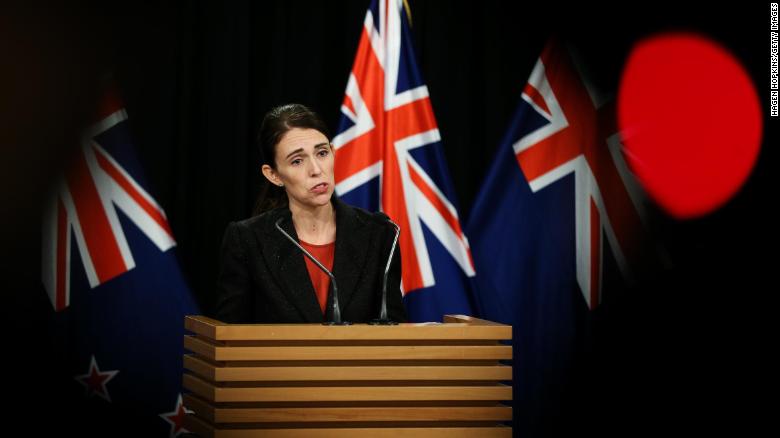
Prime Minister Jacinda Ardern described the horror as a terrorist attack, saying it was perpetrated by suspects with "extremist views" that had no place in her country or the wider world. It was one of the New Zealand's "darkest days," she said in a press conference Friday.
Authorities said that every law enforcement resource in the country was mobilized after the attack.
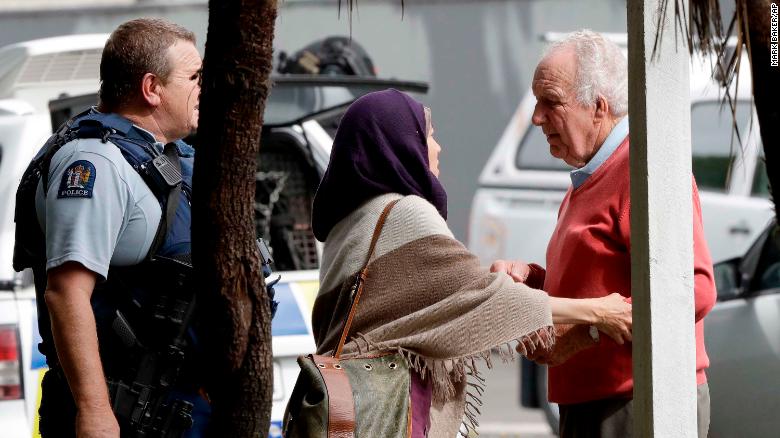
Police escort people away from outside a mosque in central Christchurch after the shootings.
Three people were arrested in connection with the shootings. A 28-year-old man was charged with murder and will appear in court Saturday morning local time. Two others were arrested on suspicion of possession of firearms. Police were investigating their ties to the incident, New Zealand Police Commissioner Mike Bush said.
Australian Prime Minister Scott Morrison said that at least one of those arrested is Australian. The atrocity was the work of an "extremist right-wing, violent terrorist," he said.
Police were not searching for any other suspects in connection with the attack but stressed the investigation remained fluid. None of those arrested in connection with the attacks had been on any security watch lists prior to the attack.
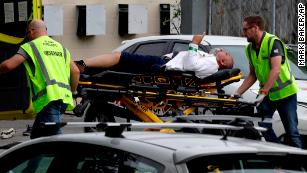
A total of 48 people, including young children with gunshot wounds, were taken to hospital.

Attack apparently broadcast live on social media

Authorities declined to discuss the potential motives behind the attack. But in a social media post just before the shooting began, an account believed to be linked to the gunman posted a link to an 87-page manifesto that was filled with anti-immigrant, anti-Muslim ideas and explanations for an attack. The manifesto was not signed.
Police said they were aware of a video shared online and broadcast live during the attack, which apparently shows a gunman walking into a mosque and opening fire. "We would strongly urge that the (video) link not be shared. We are working to have any footage removed," New Zealand police said.
The brazen nature of of the broadcast, and the tech companies' failure to prevent its proliferation online, raised profound questions about the nature of internet radicalization. In New Zealand, commentators expressed concern that the horror would sow deep divisions in a society that has largely avoided the polarizations that have spread elsewhere.
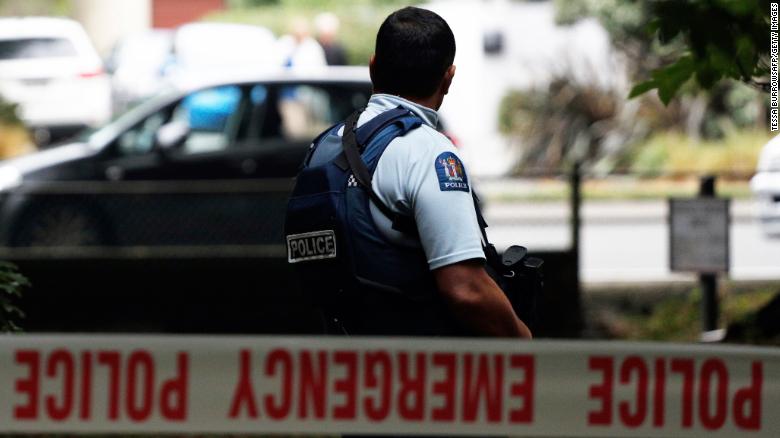
A police officer secures the area in front of the Masjid al Noor mosque.
In a statement, a spokesperson for Facebook New Zealand, Mia Garlick, said the footage was quickly taken down. "New Zealand Police alerted us to a video on Facebook shortly after the livestream commenced and we removed both the shooter's Facebook account and the video. We're also removing any praise or support for the crime and the shooter or shooters as soon as we're aware," she said.
CNN has not been able to independently confirm any information about any of the attackers or the the alleged video at this stage.
A spokesperson for Google and YouTube called the shooting a "terrible tragedy." A statement said: "Shocking, violent and graphic content has no place on our platforms, and is removed as soon as we become aware of it. As with any major tragedy, we will work cooperatively with the authorities."
Twitter removed an account it believed was linked to the main suspect and was working to keep the video of the incident off its platform, a spokesperson said. "We are deeply saddened by the shootings in Christchurch today," Twitter said in a statement. "Twitter has rigorous processes and a dedicated team in place for managing exigent and emergency situations such as this. We also cooperate with law enforcement to facilitate their investigations as required."

IEDs found in vehicle

Armed police were deployed after first receiving reports of the shootings at 1:40 p.m. local time, when mosques were packed for Friday prayers. Police said 41 people were killed at the al Noor mosque on Deans Avenue. Seven died at the Linwood mosque on Linwood Avenue, and one died in the hospital from injuries.
Mass shootings at mosques in Christchurch, New Zealand
Two improvised explosive devices were found in a vehicle linked to the attack. A number of weapons were also recovered at both locations.
The area was placed on lockdown, and police urged Christchurch residents to stay indoors and monitor the police website and social media. Worshipers were told to stay away from all mosques in New Zealand.
Later in the day, authorities evacuated properties close to a "location of interest" in the southern city of Dunedin, some 225 miles from Christchurch.

Gunman opened fire 'for 10 to 15 minutes'

One worshiper, Mohan Ibn Ibrahim, said he was inside one of the mosques when the shooting began and that he heard the gunman "continuously shooting for 10 to 15 minutes."
"It's a big mosque and there were more than 200 people inside. The gunmen came from the back side. Gunshots went on for a long time. We had to jump the wall to escape. I saw lots of broken glass and bricks on the backside of the mosque," he said.
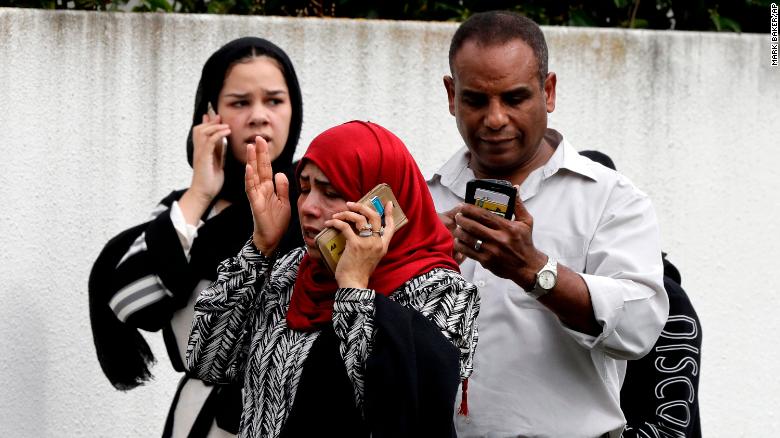
People wait outside a mosque in central Christchurch, New Zealand, Friday, March 15, 2019.
"I came to the street I saw one person got shot on his chest," he said, adding that the ambulance and police then arrived on the scene. He said that he had a friend in another mosque in the area who told him a gunman had opened fire there as well and five people were dead.
"I could not contact two of my friends who are in the mosque as well," he said.
Another witness, who did not wish to be named, said he was driving by the scene and saw a man with a "with his 3- or 4-year-old daughter" who had been shot in the back. "He was screaming like get her to the hospital and the ambulance couldn't come in until it was secured so I just got my truck and loaded up him, and his daughter, and this other guy had been shot in the leg, and took them to the hospital," he said.
One man outside the mosque said that he prayed that the gunman would "run out of bullets."
"I was thinking that he must run out bullets you know, so what I did was basically waiting and praying to God, oh God please let this guy run out of bullets," he said. He said a man told him to remain still and then the gunman shot the man "straight in the chest."
 
 
Prime Minister Jacinda Ardern speaks in Wellington, New Zealand.
In a press conference, Prime Minister Ardern described the attack as "one of New Zealand's darkest days."
"What has happened here is an extraordinary and unprecedented act of violence," she said, adding that the attackers have "no place in New Zealand."
"For now my thoughts and I'm sure the thoughts of all New Zealanders are with those who are being affected and with the families," she said.

World leaders react

Australian Prime Minister Morrison said he has asked for flags to be flown at half-staff out of respect for those killed in the attack. "Australians stand with all New Zealanders today during this dark time where hate and violence has stolen their peace and innocence. Kia kaha (stay strong)," Morrison tweeted earlier.
US President Donald Trump said in a tweet: "My warmest sympathy and best wishes goes out to the people of New Zealand after the horrible massacre in the Mosques. 49 innocent people have so senselessly died, with so many more seriously injured. The U.S. stands by New Zealand for anything we can."
In a statement, the White House said: "The United States strongly condemns the attack in Christchurch. Our thoughts and prayers are with the victims and their families. We stand in solidarity with the people of New Zealand and their government against this vicious act of hate."
Yousef bin Ahmad Al-Othaimeen, the Secretary General of the Organization of Islamic Cooperation (OIC), condemned the attacks. The OIC represents 57 nations with large or majority-Muslim populations.
"The brutal crime had shocked and hurt the feelings of all Muslims around the world, and served as a further warning on the obvious dangers of hate, intolerance, and Islamophobia," he said. Othaimeen urged the New Zealand authorities to investigate the attack thoroughly.
Sadiq Khan, the mayor of London, tweeted his condolences to the victims of the attack, and confirmed that there will be "highly visible" and armed police around mosques in the UK capital on Friday.
"I want to reassure the Muslim communities in London. I have been in touch with the Met Police. There will be highly visible policing around mosques today, as well as armed response officers, as Londoners go to pray," he said.
UK Prime Minister Theresa May sent her "deepest condolences" in a tweet. "My thoughts are with all of those affected by this sickening act of violence," she wrote.
 
 
source : BBC news
 
ALLFORMILITARY  BLOG CONCLUSION :
 
 Investigations still ongoing ,therefore it is advisable for people not to conclude on blaming other religion for the terrorist act, let us wait till findings are finished.
Thanks for reading.


GOOD NEWS FOR NDA ASPIRANTS:JAMB /NDA Fixes 11th April for UTME Exam, Postpones Mock, Re-opens Registration Portal

JAMB Fixes 11th April for UTME Exam, Postpones Mock, Re-opens Registration Portal
best military academy in the world

 jamb

NIGERIAN DEFENCE ACADEMY EXTENDS APPLICATION DEADLINE FOR 2 WEEKS
The Nigerian Defence Academy wishes to inform all applicants that the 71 Regular Course 'Application Deadline' has been extended for 2 weeks. The application will now close on Thursday, 28 March 2019.
Please, disseminate this information to the general public.
Major Abubakar Abdullahi
Academy Public Relations Officer
14 March 2019

JAMB has finally fixed 11th April, 2019 as the new official date to commence with the UTME for this year. They have also postponed the Mock Exam to be held on Monday, 1st April. It is also important to note that the 2019 Registration Portal has now been re-opened till 15th March, 2019 (by midnight), for candidates, who have already created their profiles and purchased the UTME or DE ePINS.


Candidates are to begin reprinting their Official Exam Slips as from 2nd April to see their Exam details such as approved Venues and Time Schedule for their CBT Exam. Meanwhile, those who are qualified to write the Mock Exam on the new date of 1st April do not need to reprint the reprinted exam slips, as all the details on the slips remain the same except the (mock) examination date which is now April 1.
This is indeed the perfect time for all those who are yet to get their JAMB CBT Mobile App to practice for the main exam on their mobile phone. Candidates can equally get the JAMB CBT Software for Computer Systems, to simulate the actual CBT environment on the Main UTME, which now comes up on 11th April.


JAMB’s spokesperson, Fabian Benjamin, said these changes are due to ”certain circumstances beyond the Board’s control” and that “All candidates who registered for the 2019 UTME are to ensure that they print their examination notification slips before the day of the examination as no excuses would be entertained. The public should note that the Board would not reschedule examination for any candidate


So if you are NDA aspirant and you have not applied due to financial constraints or ignorance of the closing date.
You can now register for both Jamb and NDA before the date above.
Act now!!!!

Friday, 8 March 2019

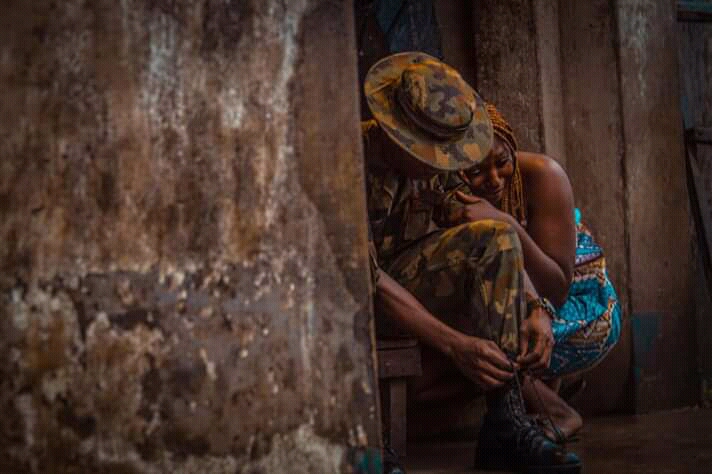
This military pictures are more emotional than you think

This Nigerian photoshoot by a yet but to be identified photographer
Actually steal the minds of people with these scenes below!!!


Well
The pictures should explain better!
Pls pray for our heroes !!!!!


Monday, 25 February 2019

THE ORIGIN OF THE TALIBANS

 talibans FLAG
The Taliban—from the Arabic word for "student,"  Talib—are fundamentalist Sunni Muslims, mostly from Afghanistan’s Pashtun tribes. The Taliban dominates large swaths of Afghanistan and a large part of Pakistan’s Federally Administered Tribal Areas, semi-autonomous tribal lands along the Afghan-Pakistan border that serve as training grounds for terrorists.
The Taliban seek to establish a puritanical caliphate that neither recognizes nor tolerates forms of Islam divergent from their own. They scorn democracy or any secular or pluralistic political process as an offense against Islam. The Taliban’s Islam, however, a close kin of Saudi Arabian Wahhabism, is far more perversion than interpretation. The Taliban’s version of Sharia, or Islamic law, is historically inaccurate, contradictory, self-serving and fundamentally deviant from prevailing interpretations of Islamic law and practice.

Origins

There was no such thing as the Taliban until Afghanistan’s civil war in the wake of the Soviet Union's troop withdrawal in 1989 after a decade-long occupation. But by the time their last troops withdrew in February of that year, they’d left a nation in social and economic shards, 1.5 million dead, millions of refugees and orphans in Iran and Pakistan, and a gaping political vacuum that warlords attempted to fill. Afghan mujahideen warlords replaced their war with the Soviets with a civil war.
Thousands of Afghan orphans grew up never knowing Afghanistan or their parents, especially their mothers. They were schooled in Pakistan’s madrassas, religious schools that, in this case, were encouraged and financed by Pakistani and Saudi authorities to develop militantly inclined Islamists. Pakistan nurtured that corps of militants as proxy fighters in Pakistan’s ongoing conflict over Muslim-dominated (and disputed) Kashmir. But Pakistan consciously intended to use the madrassas’ militants as leverage in its attempt to control Afghanistan as well.
As Jeri Laber of Human Rights Watch wrote in the New York Review of Books of the origins of the Taliban in refugee camps (recalling an article he’d written in 1986):
Hundreds of thousands of youths, who knew nothing of life but the bombings that destroyed their homes and drove them to seek refuge over the border, were being raised to hate and to fight, “in the spirit of Jihad,” a “holy war” that would restore Afghanistan to its people. “New kinds of Afghans are being born in the struggle,” I reported. “Caught in the midst of a grownups’ war, the young Afghans are under intense political pressure from one side or another, almost from birth." [...] The children that I interviewed and wrote about in 1986 are now young adults. Many are now with the Taliban.

Mullah Omar and the Taliban's Rise in Afghanistan

As civil war was ravaging Afghanistan, Afghans were desperate for a stabilizing counterforce that would put an end to the violence.
The Taliban’s most original aims were, as Ahmed Rashid, the Pakistani journalist and author of "Taliban" (2000), wrote, to “restore peace, disarm the population, enforce Sharia law and defend the integrity and Islamic character of Afghanistan."
As most of them were part-time or full-time students at madrassas, the name they chose for themselves was natural. A Talib is one who seeks knowledge, compared to the mullah who is one who gives knowledge. By choosing such a name, the Taliban (plural of Talib) distanced themselves from the party politics of the mujahideen and signaled that they were a movement for cleansing society rather than a party trying to grab power.​
For their leader in Afghanistan, the Taliban turned to Mullah Mohammed Omar, an itinerant preacher likely born in 1959 in Nodeh village near Kandahar, in southeastern Afghanistan. He had neither tribe nor religious pedigree. He had fought the Soviets and been wounded four times, including once in the eye. His reputation was that of a pious ascetic.
Omar's reputation grew when he ordered a group of Taliban militants to arrest a warlord who had captured two teenage girls and raped them. The 30 Talibs, with just 16 rifles between them—or so goes the story, one of many near-mythical accounts that have grown around Omar’s history—attacked the commander’s base, freed the girls and hanged the commander by their favorite means: from the barrel of a tank, in full view, as an example of Taliban justice.
The Taliban’s reputation grew through similar feats.
 talibans FLAG

Benazir Bhutto, Pakistan's Intelligence Services and the Taliban

Religious indoctrination in Pakistan’s madrassas and Omar’s campaigns against rapists alone were not the light that lit the Taliban fuse. The Pakistani intelligence services, known as the Inter-Services Intelligence Directorate (ISI); the Pakistani military; and Benazir Bhutto, who was prime minister of Pakistan during the Taliban’s most politically and militarily formative years (1993-96), all saw in the Taliban a proxy army they could manipulate to Pakistan’s ends.
In 1994, Bhutto’s government appointed the Taliban as protector of Pakistani convoys through Afghanistan. Controlling trade routes and the lucrative windfalls those routes provide in Afghanistan is a major source of lucre and power. The Taliban proved uniquely effective, swiftly defeating other warlords and conquering major Afghan cities.
Beginning in 1994, the Taliban rose to power and established their brutal, totalitarian rule over 90 percent of the country, in part by leading a genocidal campaign against Afghanistan’s Shiite, or Hazara.

The Taliban and the Clinton Administration

Following Pakistan’s lead, then-President Bill Clinton's administration initially supported the Taliban’s rise. Clinton’s judgment was clouded by the question that has often led American policy astray in the region: Who can best check Iran’s influence? In the 1980s, then-President Ronald Reagan's administration armed and financed Iraqi dictator Saddam Hussein under the assumption that a totalitarian Iraq was more acceptable than an unbridled, Islamic Iran. The policy backfired in the form of two wars.
In the 1980s, the Reagan administration also funded the mujahideen in Afghanistan as well as their Islamist supporters in Pakistan. That blowback took the form of al-Qaeda. As the Soviets withdrew and the cold war ended, American support for Afghan mujahideen stopped abruptly, but military and diplomatic support for Afghanistan did not. Under the influence of Benazir Bhutto, the Clinton administration voiced itself willing to open a dialogue with the Taliban in the mid-1990s, especially as the Taliban was the only force in Afghanistan capable of guaranteeing another American interest in the region—potential oil pipelines.
On Sept. 27, 1996, Glyn Davies, a US State Department spokesman, expressed hope that the Taliban “will move quickly to restore order and security and to form a representative interim government that can begin the process of reconciliation nationwide.” Davies called the Taliban’s execution of former Afghan President Mohammad Najibullah merely “regrettable,” and said the United States would send diplomats to Afghanistan to meet with the Taliban, potentially to re-establishing full diplomatic ties. The Clinton administration’s flirtation with the Taliban did not last, however, as Madeleine Albright, incensed by the Taliban’s treatment of women, among other regressive measures, halted it when she became the US secretary of state in January 1997.

The Taliban's Repressions and Regressions: A War on Women

The Taliban's long lists of edicts and decrees took an especially misogynistic view of women. Schools for girls were closed. Women were forbidden to work or leave their homes without verifiable permission. Wearing non-Islamic dress was forbidden. Wearing makeup and sporting Western products like purses or shoes was forbidden. Music, dancing, cinemas, and all nonreligious broadcasting and entertainment were banned. Lawbreakers were beaten, flogged, shot or beheaded.
In 1994, Osama bin Laden moved to Kandahar as a guest of Mullah Omar. On Aug. 23, 1996, bin Laden declared war on the United States and exerted increasing influence on Omar, helping to fund the Taliban’s offensives against other warlords in the north of the country. That lavish financial support made it impossible for Mullah Omar not to protect bin Laden when Saudi Arabia, then the United States, pressured the Taliban to extradite bin Laden. The fates and ideology of al-Qaeda and the Taliban became intertwined.
At the height of their power, in March 2001, the Taliban demolished two enormous, centuries-old Buddha statues in Bamiyan, an act that showed to the world in ways that the Taliban’s wanton massacres and oppression should have much earlier the ruthless, distorted Puritanism of the Taliban’s interpretation of Islam.

The Taliban's 2001 Downfall

The Taliban was overthrown in the 2001 American-backed invasion of Afghanistan, shortly after bin Laden and al-Qaeda claimed responsibility for the 9-11 terrorist attacks on the United States. The Taliban were never completely defeated, however. They retreated and regrouped, especially in Pakistan, and today hold much of southern and western Afghanistan. Bin Laden was killed in 2011 in a raid by US Navy Seals in his hideout in Pakistan after a nearly decade-long manhunt. The Afghan government claimed that Mullah Omar died in a hospital in Karachi in 2013. 
Today, the Taliban claim senior religious cleric Mawlawi Haibatullah Akhundzada as their new leader. They released a letter in January 2017 to newly elected US President Donald Trump to withdraw all remaining US forces from Afghanistan.
The Pakistani Taliban (known as the TTP, the same group that almost succeeded in blowing up an SUV full of explosives in Times Square in 2010) is just as powerful. They are virtually immune from Pakistani law and authority; they continue to strategize against the NATO-American presence in Afghanistan and against Pakistan’s secular rulers; and they are tactically directing attacks elsewhere in the world. ​

source:thoughtco