Friday, 22 September 2017

pensacola newsjournal


Image result for armageddon warAs the military ramped up its Hurricane Irma response on Monday, Florida bases in Hurricane Irma's path began assessing storm damage.
Bill Dougherty, spokesman for Navy Region Southeast, said the Navy's two bases in Jacksonville — Jacksonville Naval Air Station and Mayport Naval Station — appeared to be weathering the storm. 
"We've had some reports of power outages, but nothing major," he said, as the bases remained on lockdown waiting for Irma to pass.  
Navy leaders were expecting updates on the condition of Key West Naval Air Station later on Monday, Dougherty said.
"We were thankful that there were no injuries reported (from Key West NAS )," he said. 
On its Facebook page, the Key West base said it had called additional "mission essential" personnel to return and began assisting with storm recovery. 
Other bases in the storm's path, including Tampa's MacDill Air Force Base, remained closed. 
Navy and Air Force bases throughout Florida flew aircraft and moved ships out of the storm's path long before Irma's arrival.
The Air Force's Special Operations Command at Hurlburt Field moved some aircraft just in case the storm affected the western Panhandle, said Air Force Lt. Kayshel Trudel, a spokeswoman for the base. 
On Monday, Hurlburt became a staging area for a California Army National Guard unit called in to help with relief efforts in other parts of the state. Trudel said the guard unit brought two cargo planes loaded with relief supplies, along with numerous helicopters for search and rescue. 
Nearby Eglin Air Force Base has become a staging area for FEMA, said base spokesman Andy Bourland.  
The U.S. Air Force Reserve has activated all of its special mission units in response to Hurricanes Irma and Harvey and the fires on the West Coast. The reservists were doing everything from spraying insecticides to fight Zika outbreaks in the storms' aftermath to flying into the hurricanes and monitoring wind speeds and other conditions, the agency said in a news release. 
Florida Gov. Rick Scott activated nearly 8,000 members of the Florida National Guard to respond to Irma. Scott said the guard units were doing search-and-rescue missions, supporting law enforcement and providing other assistance. 
The Army said late Monday that more than 16,700 soldiers, members of the U.S. Army Corps of engineers and civilian support staff were helping with the recovery effort in Florida, the U.S. Virgin Islands and Puerto Rico.  
Members of the Corps of Engineers were monitoring the Herbert Hoover Dike on Florida's Lake Okeechobee, as well as working to restore power in the U.S. Virgin Islands and in Puerto Rico, according to a new release from the Army. 
The Navy has sent eight ships to support recovery efforts, including the aircraft carrier USS Abraham Lincoln. 
Navy Lt. Cmdr. Brian Wierzbicki said the sailors and marines were prepared to help with medical evacuations, rescues, humanitarian relief and however else they are needed. 
Wierzbicki said the ships would also help any Florida bases impacted by the storm. 
"We will provide whatever support is requested," he said. 
The U.S. Northern Command said early Monday the USS Wasp had completed 44 medical evacuations for critical care patients from St. Thomas to St. Croix. Wierzbicki said Navy and Marine crews were also flying search-and-rescue mission in the U.S. Virgin Island. 
The Coast Guard said Monday it was preparing for search and rescue flights, damage assessment and pollution response in all ares impacted by the storm. 


This article is not written by me but based on research

Not by number


Image result for DEAD SOLDIERS
Not by number
“Thus saith the LORD unto you,Be not afraid nor dismayed by reason of this great multitude;for the battle is not yours,but Gods” (2nd chronicles 20:15)
In  1792,the Duke of Brunswick,Commander in-chief of the allied army during the French Revolution threatened to reduce Paris to ashes with about Ninety thousand men.Shortly after his threat ,the blast of God destabilized him and in the same year almost all his army was destroyed  by a fatal disease and  himself obliged to retreat .This incident affirms Gods promise,in our text,to fight for his children.

MILITARY CHILLS FOR OUR HEROES


Image result for laughing soldiers
MILITARY JOKES: LAUGH IT OUT
DEAR reader’s military or civilian pride will ultimately bring someone low. Pride in most cases is a symptom of weak personality.Asyou go out today; prove your life worthy of staying real. Check your ways and make sure you are not living a deceptive life.
The story tells of a young military officer, a colonel, who was just posted to a new barracks. This was a time when mobile phones was not available and those who had telephones use mobile phones only and lines .on resuming, the man wanted everybody around to know  that he was well connected, and he used to blow his own trumpet. One day he was in his office and he heard a knock at the door. As soon as he invited the visitorto come in, he swiftly lifted the receiver from the cradle and started to talk.
PROUD COLONEL: Hello………Oh General….., yessir. I have heard sir .I will see you later in the evening, sir. (He dropped the receiver and look at the sergeant standing before him arrogantly.)
SEARGENT: (saluted) Sir.
PROUD COLONEL: That was the GOC serge, what can I do for you?
SERGEANT: I came to connect your phone sir.

Wednesday, 20 September 2017

THE SPECIAL FORCE OF THEN

Black-clad figures with muffled faces skitter through a courtyard, swarming over walls like spiders and running lightly across rooftops, quick as cats.
An unsuspecting samurai sleeps peacefully as these shadows permanently silence his bodyguards. The bedroom door slides open without a sound, an upraised blade glints in the moonlight, and...
This is the ninja of the movies and comic books, the stealthy assassin in black robes with magical abilities in the arts of concealment and murder.
This wraith-like being is very compelling, to be sure. But what is the historical reality behind the popular culture icon of the Ninja?

Origins of the Ninja

It is difficult to pin down the emergence of the first ninja, more properly called shinobi — after all, people around the world have always used spies and assassins. Japanese folklore states that the ninja descended from a demon that was half man and half crow. However, it seems more likely that the ninja slowly evolved as an opposing force to their upper-class contemporaries, the samurai, in early feudal Japan.
Most sources indicate that the skills that became ninjutsu, the ninja's art of stealth, began to develop between 600 to 900 and Prince Shotoku, who lived from 574 to 622) is said to have employed Otomono Sahito as a shinobi spy.
By the year 907, the Tang Dynasty in China fell, plunging the country into 50 years of chaos and forcing Tang generals to escape over the sea to Japan where they brought new battle tactics and philosophies of war.
Chinese monks also began to arrive in Japan in the 1020s, bringing new medicines and fighting philosophies of their own, with many of the ideas originating in India and making their way across Tibet and China before turning up in Japan. The monks taught their methods to Japan's warrior-monks, or yamabushi, as well as to members of the first ninja clans.

The First Known Ninja School

For a century or more, the blend of Chinese and native tactics that would become ninjutsu developed as a counter-culture, without rules, but it was first formalized by Daisuke Togakure and Kain Doshi around the 12th century.
Daisuke had been a samurai, but he was on the losing side in a regional battle and forced to forfeit his lands and his samurai title. Ordinarily, a samurai might commit seppuku under these circumstances, but Daisuke did not.
Instead, in 1162, Daisuke wandered the mountains of southwest Honshu where he met Kain Doshi, a Chinese warrior-monk — Daisuke renounced his bushido code, and together the two developed a new theory of guerrilla warfare called ninjutsu. Daisuke's descendants created the first ninja ryu, or school, the Togakureryu.

Who Were the Ninja?

Some of the ninja leaders, or jonin, were disgraced samurai like Daisuke Togakure that had lost in battle or had been renounced by their daimyo, but fled rather than committing ritual suicide. However, most ordinary ninjas were not from the nobility.
Instead, low-ranking ninjas were villagers and farmers who learned to fight by any means necessary for their own self-preservation, including the use of stealth and poison to carry out assassinations.
As a result, the most famous ninja strongholds were the Iga and Koga Provinces, mostly known for their rural farmlands and quiet villages.
Women also served in ninja combat. Female ninja, or kunoichi, infiltrated enemy castles in the guise of dancers, concubines or servants who were highly successful spies and sometimes even acted as assassins as well.

Samurai Use of the Ninja

The samurai lords could not always prevail in open warfare, but they were constrained by bushido, so they often hired ninjas to do their dirty work — secrets could be spied out, opponents assassinated, or misinformation planted, all without sullying a samurai's honor.
This system also transferred wealth to the lower classes, as the ninja were paid handsomely for their work. Of course, a samurai's enemies could also hire ninja, and as a result, the samurai needed, despised, and feared the ninja — in equal measure.
The ninja "high man," or jonin, gave orders to the chunin, "middle man," who passed them on to the genin, or the ordinary ninja. This hierarchy was also, unfortunately, based on the class the ninja had come from before training, but it wasn't uncommon for a skilled ninja to ascend the ranks well beyond his or her social class.

The Rise and Fall of the Ninja

The ninja came into their own during the tumultuous era between 1336 and 1600, where an atmosphere of constant war, ninja skills were essential for all sides, playing a key role in the Nanbukucho Wars (1336 - 1392), the Onin War (1460s), and even through the Sengoku Jidai, or "Warring States Period" — where they aided samurai in their internal power struggles.
The ninja were also an important tool during the Sengoku Period (1467 - 1568) but also a destabilizing influence. When war-lord Oda Nobunaga emerged as the strongest daimyo and began to reunite Japan in 1551 to 1582, he saw the ninja strongholds at Iga and Koga as a threat, but despite quickly defeating and co-opting the Koga ninja forces, Nobunaga had more trouble with Iga.
In what would later be called the "Iga Revolt" or Iga No Run, Nobunaga attacked the ninja of Iga with an overwhelming force of more than 40,000 men. Nobunaga's lightning-quick attack on Iga forced the ninja to fight open battles, and as a result, they were defeated and scattered to nearby provinces or the mountains of Kii.
While their power-base was destroyed, the ninja did not vanish entirely. Some went into the service of Tokugawa Ieyasu, who later became shogun in 1603, but the much-reduced ninja continued to serve both sides in struggles. In one famous incident from 1600, a ninja sneaked through a group of Tokugawa's defenders at Hataya castle and planted the flag of the besieging army high on the front gate!
The Edo Period under the Tokugawa Shogunate from 1603 to 1868 brought stability and peace to Japan, bringing the ninja story to a close. Ninja skills and legends survived, though, and were embellished to enliven the movies, games and comic books of today.

NATURAL ENEMIES

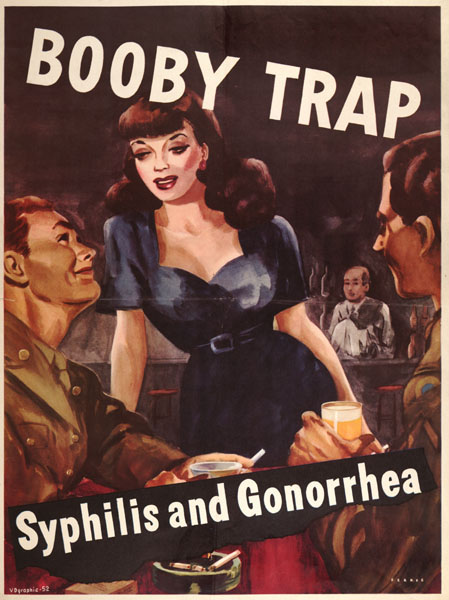
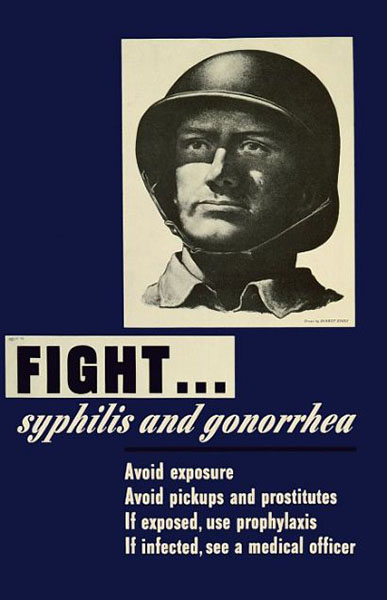
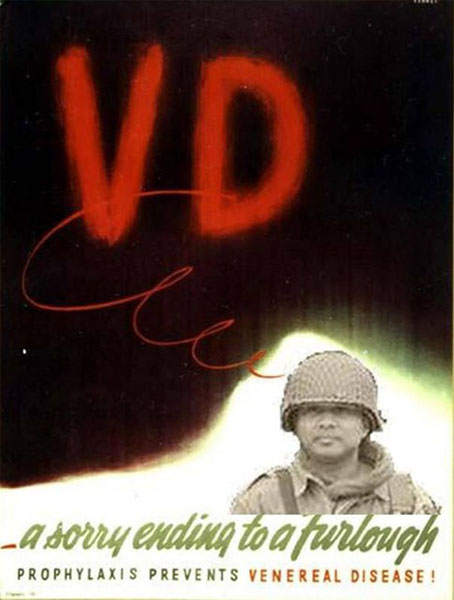
Army medical records dating back to the Revolutionary War show significant soldier losses due to venereal diseases. In a two-year period during the Civil War, the Union Army documented 100,000 cases of gonorrhea. During World War I, the Army lost 7 million person-days and discharged more than 10,000 men because they were ailing from sexually transmitted diseases. Once penicillin kicked in in the mid-1940s, such infections were treatable. But as a matter of national security, the military started distributing condoms and aggressively marketing prophylactics to the troops in the early 20th century.
The military took its prophylactics campaign seriously, but that didn’t mean its VD posters couldn’t have a little fun. One US Navy training film from 1942, USS VD: Ship of Shame, urged sailors to “put it on before you put it in.” .
During World War I, more than 18,000 doughboys came down with STDs. In response, the military started handing out condoms to plebes, and it launched an aggressive decades-long promotional campaign. The American Social Hygiene Association

Penicillin didn’t go into wide use until after World War II, meaning syphilis and gonorrhea remained serious threats to soldiers’—and the Army’s—staying power.

Commissioned by the American Social Hygiene Association, cartoonist C.D. Batchelor of the New York Daily News sketched several editorial cartoons aimed at convincing troops to resist temptation. The American Social Hygiene Association

Several images stressed the woman’s role as the hovering black widow ready to strike… C.D. Batchelor, The American Social Hygiene Association

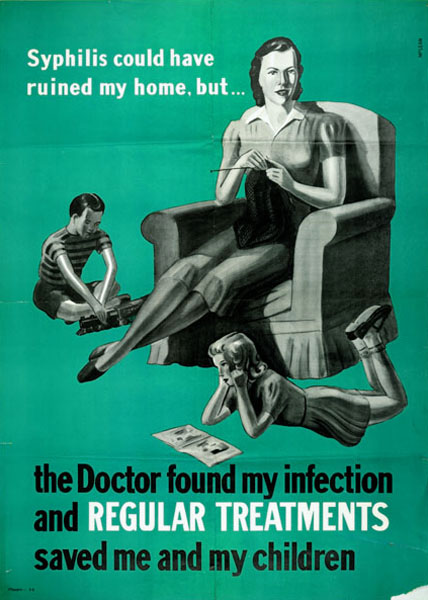
…Though some appealed to the homemaker infected by a straying husband.

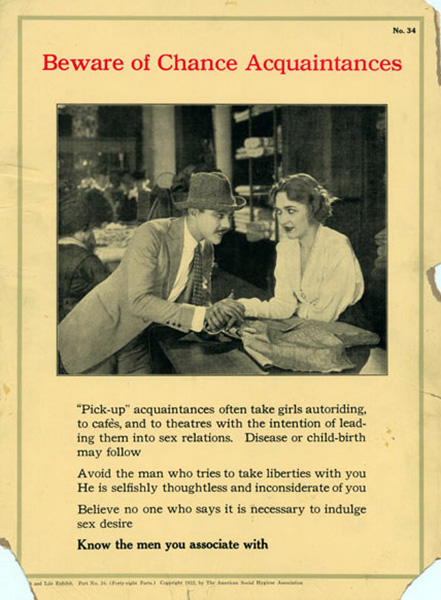
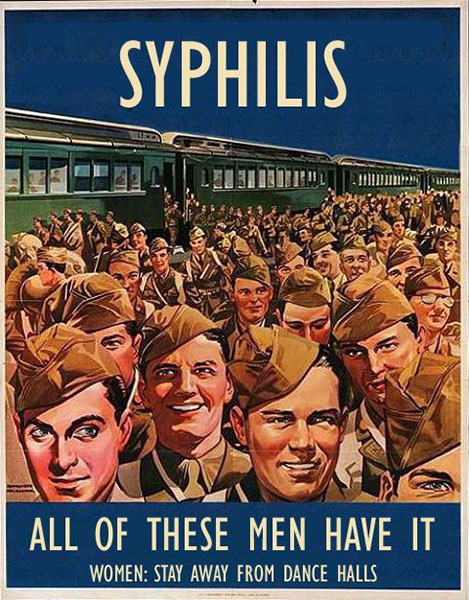
Some messages are timeless: Stay away from douchebags who just want in your pants. The American Social Hygiene Association

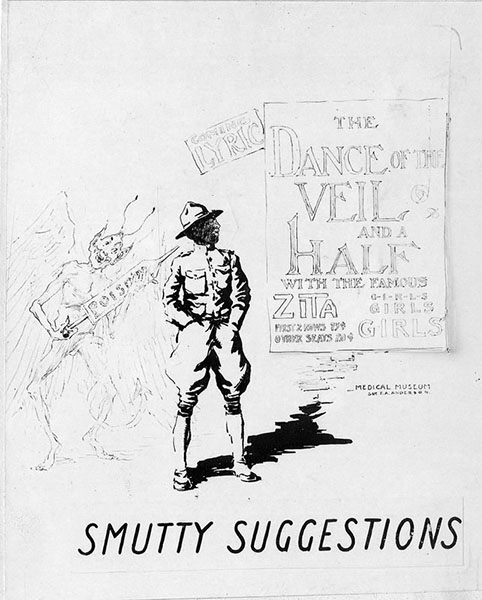
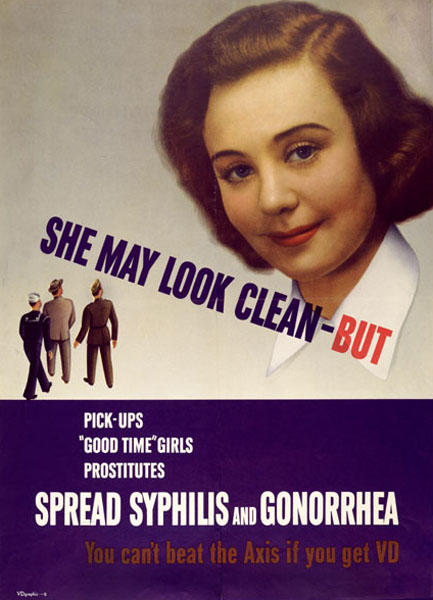
>Propaganda at work: Girls = Poison. Poison in a gigantic syringe. F.A. Anderson, Army Medical Museum

Mercury was considered standard treatment for STDs, until Penicillin replaced it in the mid-1940s. Designed and reproduced by 912th Engineer Air Force Headquarters Co., Orlando, Florida

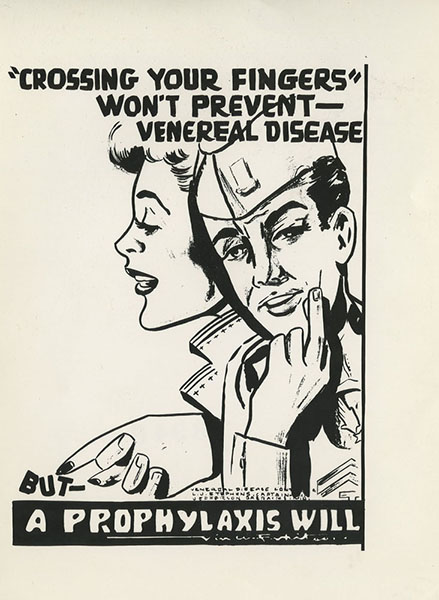
This World War II soldier is either crossing his fingers or telling us to f*** off. Venereal Disease Control Office, Capt. L.J. Stephens, Medical Corps, Jefferson Barracks, Missouri

Prophylactic campaigns weren’t just for US troops. Here’s an ad that ran “down under” during World War II. Cyril Jones, 4th Medical Corps Division, Australia.

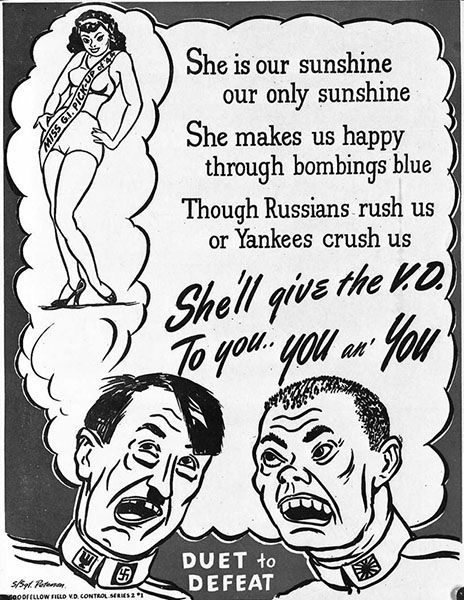
Caricatures of Axis enemies made for common VD art, herewith Japan’s Gen. Hideki Tojo and Hitler. Mussolini and Stalin were also frequently portrayed. Staff Sgt. Peterson, Goodfellow Field Venereal Disease Control Series 2, No. 1

Penicillin has proven so effective in staving off syphilis and gonorrhea that new recruits are no longer screened for the diseases. They are, however, tested for HIV. 1940, National Library of Medicine, History of Medicine Collection

And the Army still liberally doles out free condoms, stressing that “Readiness doesn’t end when the uniform comes off.” WPA

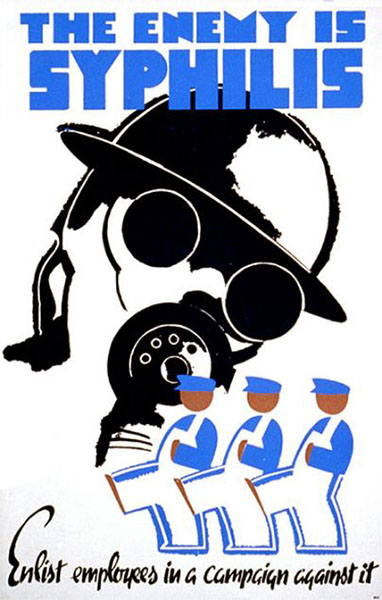
Before World War II, syphilis was the fourth leading cause of death in the US, behind only tuberculosis, pneumonia, and cancer.

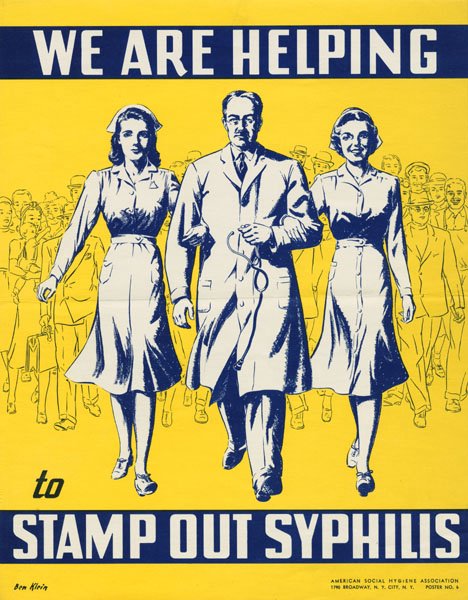
Part of the WPA syphilis-awareness campaign. The WPA produced more than 20 anti-syphilis posters in the early 1940s. WPA Chicago, 1940

Another WPA-era poster. WPA

An English poster used in the lead-up to D-Day with a different take on the dangers of syphilis. This time, it’s the gents who are the diseased floozies. British, 1944

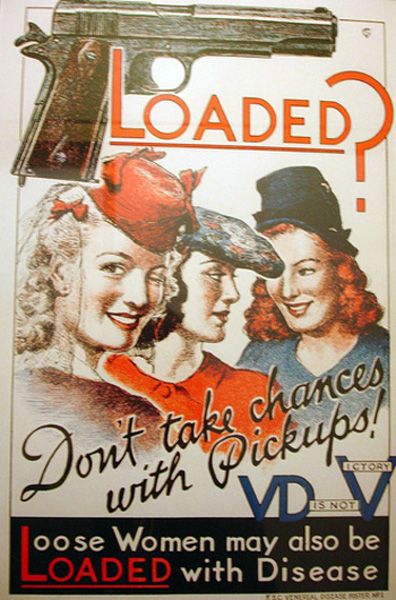
The message here seems to be that loose women wear hats (and maybe carry guns). After World War II the US military scaled back their campaign against these, now curable, communicable diseases.

Said Bill Calvert, chairman of the DOD’s STD prevention committee in 2000: “We’d like to provide condoms, much like we do hard-hats or earplugs, as protective equipment to keep our troops safe.” WPA